
Zug: A Trading House for the World
How a poor little canton learned to connect capital and strangers productively
When I moved with my family from Vienna to the canton of Zug in 2024, I arrived in a place whose everyday achievement becomes fully apparent only through living there: safety and reliability, short distances, an astonishing proximity of global business and nature, authorities who answer, and a landscape that is not merely admired but inhabited. A newcomer has, at first, nothing to explain about this. He has to notice what generations before him built and to be grateful for it.
Zug is neither a libertarian Arcadia nor merely a tax dodge. That is precisely what makes the canton so remarkable. Its success story is real because it requires no miracle. It rests on long prior investment, institutional capacity to learn, and the rare art of receiving foreign capital and foreign people without wholly losing its own measure. The legends about Zug fall short; the actual achievement is greater.
In 1817, the canton of Zug ranked last in per capita contributions to the federal government, alongside the three founding cantons. Geneva contributed five times as much; the Swiss average more than three times as much. In 2025, Zug paid 431 million francs into the national fiscal equalisation scheme, more than the canton of Zurich. Per inhabitant, that came to 3,321 francs. Between these two figures lie some two hundred years of economic history. One could tell this story as a miracle, as a triumph of tax policy, or as the scandal of an especially successful tax haven. All three narratives fall short.
The rise of Zug is interesting precisely because it cannot be reduced to a single cause. Industrialisation arrived late, capital often came from outside, and many decisive entrepreneurs were immigrants. The railway was invented elsewhere, the Swiss domestic market was driven forward by larger cantons, and the airport stands in Zurich. Even the tax policy that today seems the very essence of Zug received important impetus from Zurich lawyers. Zug's distinctive achievement was not to invent everything itself, but to recognise what was useful, fit outside impulses into an order of its own, keep rules stable, and be reachable when someone called. Such compatibility is no lesser form of entrepreneurship. It is one of its most important political preconditions.
That sounds more modest than a miracle. But it is more significant. For the example shows how prosperity is ordinarily created in reality: not through a grand plan, but through the gradual densification of an order in which ever more strangers become willing to place capital, knowledge, labour, and trust at one another's disposal. They need share neither the same origins nor the same goals. It suffices that they offer each other something the other side values more highly. Zug condensed this voluntary exchange in a small space and became a trading house for the world, a small commercial hub for global connections.
A serious appreciation must nevertheless ask what could endanger such an achievement. The warnings in this essay do not arise from the disappointment of a newcomer, but from European historical experience. Successful orders are seldom destroyed in a day; more often, they slowly consume their own preconditions. Where much capital flows, intermediaries and promoters may settle alongside entrepreneurs, their vocabulary growing faster than their contribution to value. Where taxes flow abundantly despite low rates, even a small state may unlearn frugality. It is precisely because Zug has done so much right that these dangers deserve to be named early.
Zug in the Alpine Region
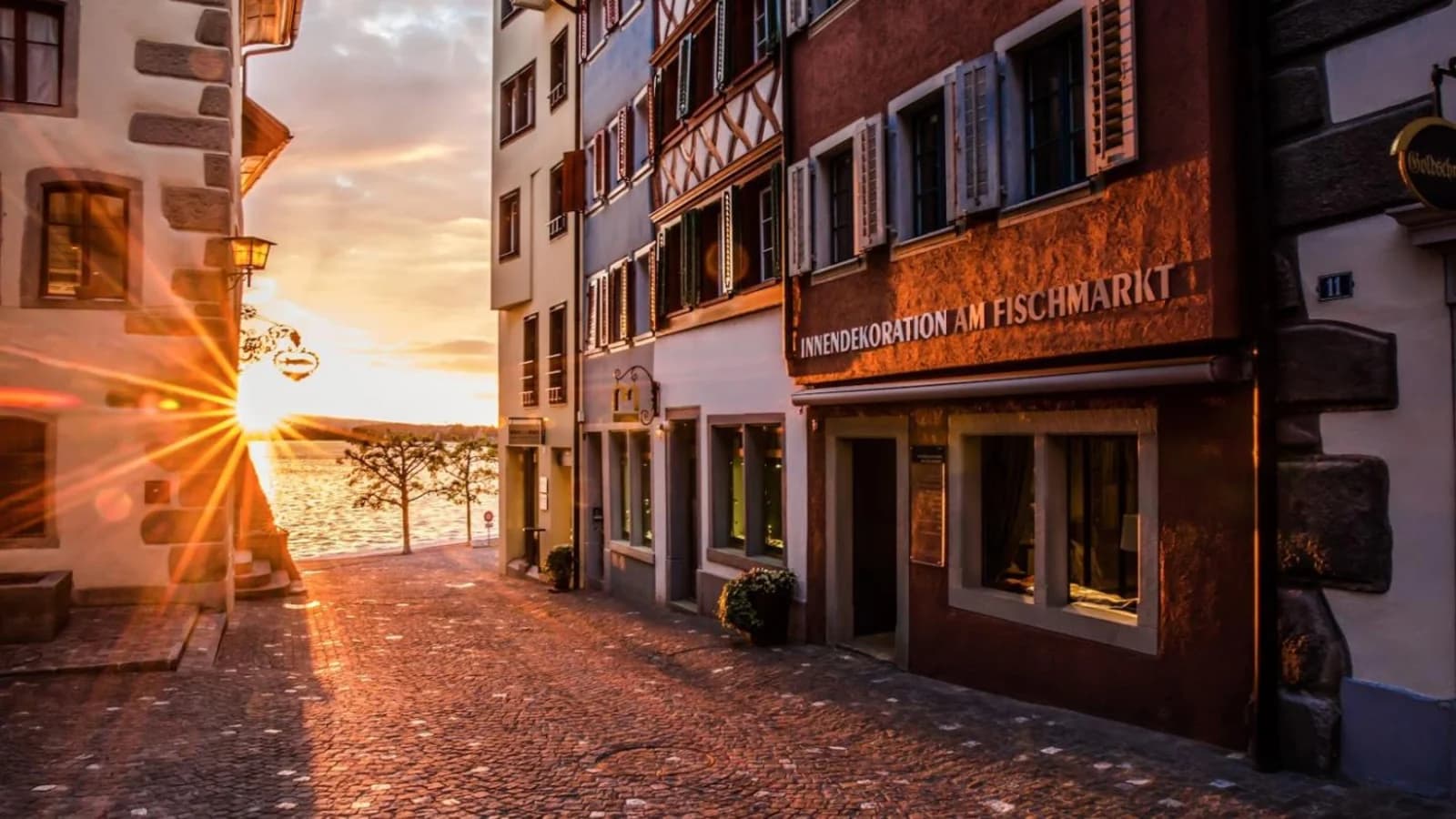
For a long time, the Alpine region was one of the richest and most interesting in the world. Bavaria, Tyrol, northern Italy, Switzerland, and Liechtenstein were, until quite recently, especially attractive for crafts, commerce, industry, and wealth creation. This is by no means self-evident. The Alps are not a forgiving landscape. Life is harsh, land is scarce, provisioning is laborious, and the weather unpredictable. Mountain regions have therefore usually remained poor. Yet the Alpine region specifically became prosperous across large stretches of its history. The story of Zug is a particularly concentrated, late-modern part of this Alpine puzzle.
The European distinctiveness always lay in the combination of proximity and separation. Valleys, lakes, rivers, and mountain ranges divided people into manageable spaces; passes, paths, markets, and short distances reconnected them. One could see from the mountain into one's own valley, and from the valley already into the next. Neighbours were close enough to learn from one another and separate enough to try different solutions. From geographical articulation arose political and economic diversity. Borders were not only obstacles. They created transitions, nodes, and competition.
Zug is not a high-alpine canton, but it lies squarely in the pre-Alpine region. The Ägerital valley, the Lorze river, the Lake of Zug, small-scale municipalities, and proximity to passes and trade routes combined peasant self-reliance with transit and exchange. Its milder situation in particular made the Alpine order compatible with broader connections. The canton could make use of the division of labour with Zurich and Lucerne without being absorbed into a large plain or metropolis. From farmers, home workers, and craftsmen came factory workers, technicians, and entrepreneurs; from paths came railway lines; from the market town came an international business location. The forms changed; the fundamental problem remained: scarce means had to be preserved and productively combined under conditions of uncertainty.

This Alpine experience is neither a glorification of rural life nor folk-costume folklore. It reveals an economic and social order of measure. Small units, personal risk, visible boundaries, long-term stewardship, and skepticism towards those who earn their bread by talk alone formed a fertile ground for entrepreneurship. Zug did not become rich because its inhabitants followed some unchanging national character. It became rich because some of these habits encountered large markets, foreign capital, modern technology, and a comparatively limited state.
From this arises a historical danger. The Alpine virtues developed under performance pressure, scarcity, and visible consequences; lasting prosperity can reduce that pressure, conceal mistakes, and make inherited capital goods appear to be natural entitlements. The cultivated landscape then risks becoming an expensive stage set; the obstinate owner, a managed man of means; the cooperative, an apparatus for distributing grants; and the craftsman, a service provider for status consumption. This is not a final verdict on Zug, but the standard supplied by the history of the successful Alpine region itself. The same canton that overcame its poverty also possesses the habits needed to resist such squandering of prosperity.
The Wealth That Was None
Poverty is simply the absence of prosperity and the normal condition of humanity. Living directly from hand to mouth is possible in only small parts of the world. Usually capital is needed to survive, and it is capital that determines long-term and sustainable prosperity. Capital is, however, scarce, because it must be wrested from nature and from human consumption impulses. The Alpine paradox is particularly sharp in Zug. What requires explanation is not its earlier poverty but its later prosperity, especially where, in retrospect, it seems self-evident. The landscape around the Lake of Zug looks today as if it had always been waiting for international headquarters, pharmaceutical companies, commodity traders, and asset managers. In reality, Zug at the start of the nineteenth century was an agrarian, poor little canton. In the mountain areas, livestock farming and dairy dominated; in the valley, arable and fruit cultivation. Home work for Zurich merchant-publishers supplemented meagre incomes. Mechanical spinning had already displaced this work before the first factory stood in the canton itself.
Industrialisation began in 1834 with the spinning mill in Unterägeri, more than thirty years later than in Zurich and eastern Switzerland. Spinning mills in Neuägeri and Baar followed. They lay on the Lorze, because before coal and electricity made factory locations more flexible, water power was the decisive energy source. The Lorze was thus the first Zuger location policy. It required no vision statement and no development agency, only a productive combination of nature, knowledge, labour, and capital.
Even this first phase shows how open the Zuger achievement was from the beginning. The startup capital came predominantly from Zurich, where earlier industrialisation and patrician fortunes had already created surpluses. The initiative for founding the spinning mill came from the Zuger family Henggeler; the Zurich cotton industrialist Heinrich Schmid and further outside investors made it viable. Machinery and technical knowledge came from Zurich, Alsace, and, indirectly, England. The cotton came largely from plantations in the American South. The labour force consisted initially of poor people from Zug and other cantons, among them many women and children. In the first Zuger factory world, local initiative, foreign capital, imported knowledge, global raw materials, and a labour regime whose harshness is hard to bear by today's standards were already converging.
The second wave of industrialisation from 1880 onward was broader. Metal goods, machinery, electrical engineering, banks, and construction firms joined textiles and foodstuffs. From the electrical engineering firm Theiler and Co. came Landis and Gyr; from the galvanising works came, later, V-Zug. Bossard had begun with ironmongery as early as 1831. The Cham paper mill, the Anglo-Swiss Condensed Milk Company, and new engineering works connected Zug with national and international markets. Decisive now was less the Lorze than the connection: in 1864 came the rail link to Zurich and Lucerne, in 1881-82 the connection to the Gotthard line, in 1897 the direct line via Thalwil to Zurich. Railways turned proximity into accessibility.
By 1910, per capita national income in Zug stood some ten percent above the Swiss average, placing the canton sixth in the ranking. Long before the celebrated tax policy, the former laggard had already become an above-average industrialised location. The later ascent, therefore, did not fall from the sky. The tax miracle required a pre-industrial memory of commerce, an industrial capital structure, transport, banks, craftsmen, technicians, entrepreneurs, and an administration that had learned to cope with change.
Foreign Capital and the Virtue of Compatibility
Capital is something other than a sum of money. It arises from the combination of goods, knowledge, people, relationships, and infrastructure into a structure capable of yielding returns. A factory without skilled workers, suppliers, distribution channels, and responsible owners is merely a hall full of old machines; a company register without courts and enforceable property rights is merely paper. The density of banks, lawyers, and trustees proves nothing in itself about capital formation.
What looks like a lack of rootedness was, economically, a strength. Capital is not a homogeneous, arbitrarily distributable sum. It is tied to particular people and contexts; its value can disappear when one extracts it from them. Zug offered such contexts new ground.
Zug was, in this, no blank slate. Foreign capital finds connection only where someone has already built the socket. The local side of the story consisted in the capacity to absorb outside impulses, translate them into rules, and extend them with complementary services. Engineers, construction firms, schools, and accessible authorities helped turn a tax address into a genuine business location. Lawyers, trustees, and banks likewise created the cross-border intelligibility without which many establishments would not have succeeded: they reduced uncertainty, clarified ownership, and made foreign legal spaces accessible. The historical warning begins where such professions no longer primarily facilitate real business, but live off legal and fiscal complexity which productive people never ordered. A growing share of the location's yield then flows to an intermediary layer between owner, entrepreneur, and state. The origin of a piece of capital explains little about its effect. What matters is whether it is consumed, parked, politically skimmed, or built into a living structure.
Large Market, Small Politics
Perhaps the most important location advantage Zug always possessed lay outside its borders. The canton is small, but its market never was to the same degree. Even the agrarian canton sold livestock, dairy products, dried fruit, and cherry schnapps beyond its borders. Zurich merchant-publishers had organised Zuger home work since the seventeenth century, connecting remote households with distant textile markets. Traders, kinship ties, annual fairs, and the town of Zug as a regional market created connections long before any legislator declared them a domestic market. Market access begins with people who know routes, prices, and buyers, not with a political map.
Later, technology and capital deepened these connections. Zurich entrepreneurs brought machines, knowledge, and financing to the Lorze. Railway companies connected Zug to Zurich and Lucerne in 1864, to the Gotthard line in 1881-82, and directly to Zurich via Thalwil in 1897. Banks financed larger ventures; telegraph and telephone accelerated the transmission of news; international companies brought their own distribution and procurement networks. The market thus did not grow concentrically from a capital city. It emerged as a network of many nodes, in which Zug, on account of its position, reliability, and compatibility, was able to attract ever more connections.
Here lies a decisive tension: the division of labour demands large markets, but political accountability demands small units. Knowledge of the particular circumstances of time and place resides with entrepreneurs, municipalities, and property owners, not in a distant centre. Markets therefore need not take on the size of political authority. Zug could trade with Zurich, Lucerne, and the world without surrendering its cantonal independence.
Zug additionally profited from Zurich: from the airport, from universities and universities of applied sciences, from the financial centre, from the labour market, from lawyers, culture, and industrial knowledge. This has polemically been called free riding, because the canton did not have to maintain many of the services of a large city itself. It is more accurate to see in it, first of all, a successful division of labour. The relevant objection begins only where costs are not voluntarily borne or contractually compensated but politically shifted onto others. Even a successful canton remains part of a larger capital structure that it neither created nor can sustain alone. That Zug could use this structure so effectively without itself becoming a large city belongs precisely among its locational achievements.
Centrality Without a Large City
The locational advantage cannot, however, be dismissed as mere free riding. In Zug the spatial formula of the successful Alpine region repeats itself: proximity and separation. The canton lies in the centre of central Switzerland and at the same time on the edge of the large Zurich economic area. Its easily accessible wider catchment area encompasses well over two million people. Zurich and Lucerne are reachable by rail in about twenty minutes; Zurich Airport in about forty. Roads and railways connect the canton with Switzerland's major economic regions and, via the Gotthard axis, with southern Europe. For so small a place, this represents an extraordinary density of reachable workers, customers, universities, banks, hospitals, cultural offerings, and international connections.
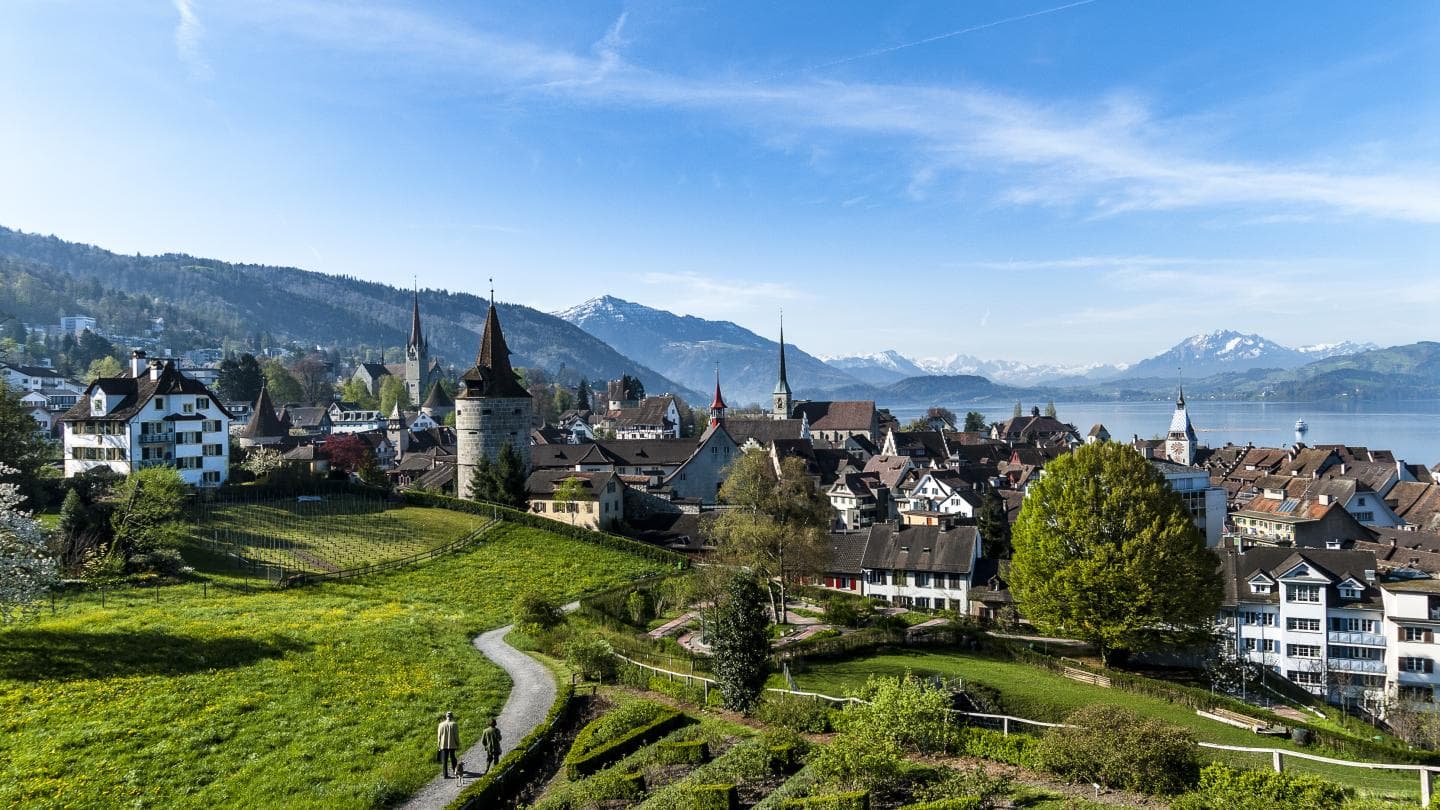
What is distinctive is the combination of this centrality with the opposite of a large city. Between the Lake of Zug and the Ägerisee, the Lorzentobel gorge, wooded hills, moraine landscapes, and the pre-Alps, there remained a beautiful, manageable canton. A few minutes separate international headquarters from meadows, forests, bathing spots, and hiking trails. The Alps lie within view; villages, despite growth, have in many places retained their own character. The natural idyll is not merely a backdrop for real estate brochures. It belongs to the genuine use value of the location.
Quality of life is a capital good, even when it appears in no company balance sheet. Safety, cleanliness, short distances, good schools, functioning infrastructure, proximity to nature, and the possibility of combining family and international work without the daily attrition of a large city influence location decisions. Entrepreneurs and investors relocate not only legal entities but frequently their centre of life. Skilled workers do not stay for a salary alone when daily life has become unbearable. Zug offers an exceptionally high quality of life precisely because it makes the possibilities of a large economic area accessible without itself becoming a city of millions.
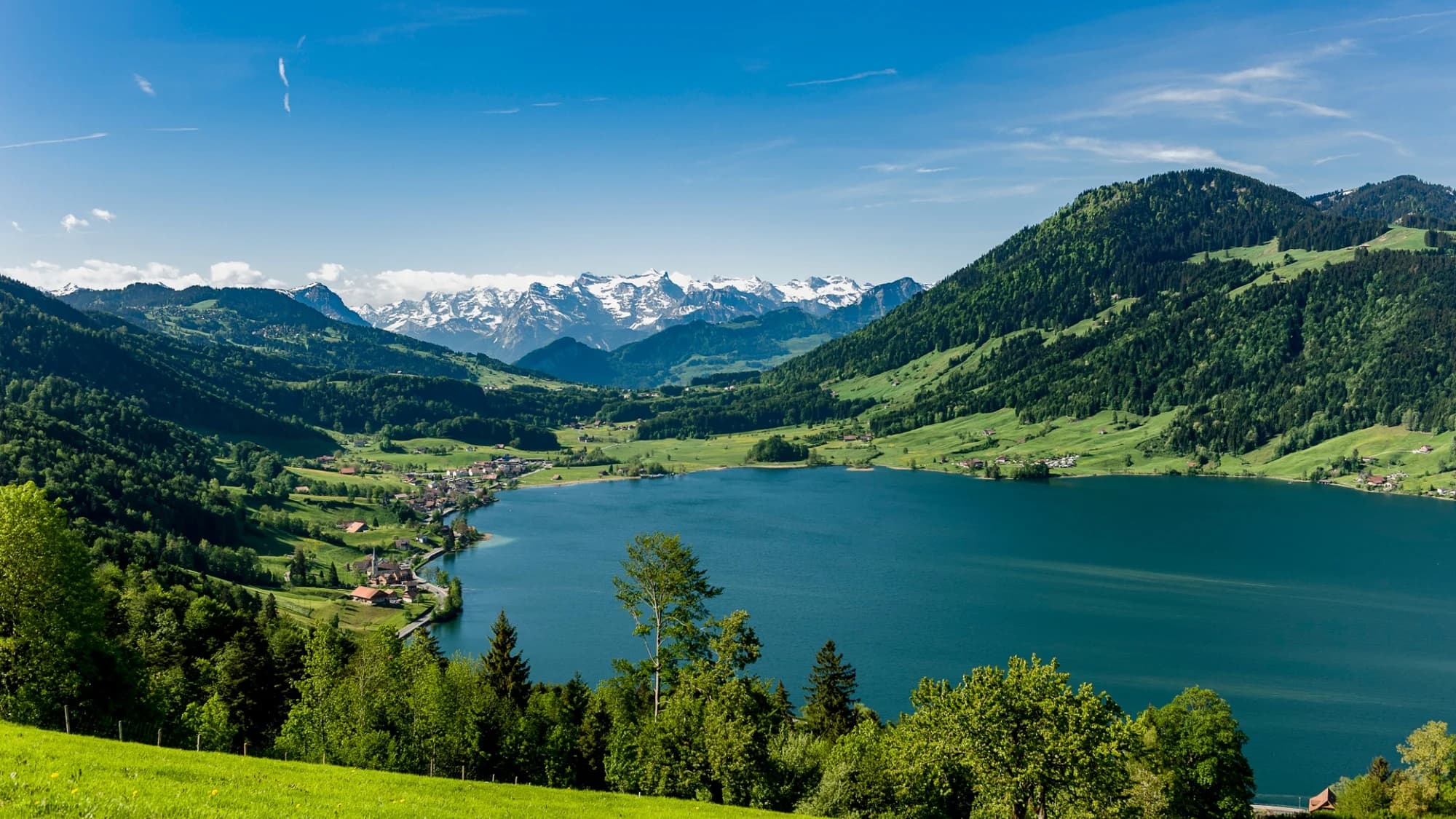
This advantage explains part of the high land prices and at the same time limits the simple tax-haven narrative. Taxes may open the door, but location, nature, and everyday livability move people actually to enter and remain. Whoever regards Zug merely as a letterbox underestimates the location. Its beauty is a reason to concentrate growth spatially, not to prevent it in general.
Taxes as a Price and Policy as the Discovery of Location
The history of Zug's tax miracle begins, fittingly, with a failure. In 1921 the canton adopted a special tax regime for holding companies, but set the burden in the final legislation so high and so vaguely that almost no one came. In 1926 a single holding company with capital of 500,000 francs was domiciled there; by the end of 1927 there were five. The Zurich commercial lawyer Eugen Keller-Huguenin recognised the unused opportunity and supplied the Zuger finance directorate with ready-drafted proposals. In 1930 a new law came into force that taxed holding companies and pure domiciliary companies considerably more favourably.
Even this law initially triggered no boom. The Great Depression took away the profits that companies might have wanted to optimise for tax purposes. Zug ran into debt, tax revenues fell, and in 1943 the electorate even rejected a fiscal consolidation act. Only after the Second World War did the rules created earlier meet a new environment: reconstruction, German and American companies, European integration, rising profits, and growing cross-border business. Institutions can look like useless sunk costs for a long time before their character as capital is revealed.
The Zuger model gained legitimacy because it was not confined to secret individual deals. After the war the canton granted no company-specific tax concessions. General rates fell, social deductions rose, and the relief was thereby made capable of winning majority support. Tax Commissioner Anton Koch and Finance Director Hans Straub cultivated what they called Steuerruhe, a tax peace: companies should be able to count not only on a low rate but on a stable one. Later, binding advance tax rulings were added, that is, the possibility of obtaining clarity about the treatment of a business model before establishing a presence.
The decisive element was therefore not the lowest percentage. It was the predictability of a service in return. From the payer's point of view, taxes are initially a price without a voluntary contract. The more obscure the service, the more arbitrary the assessment, and the more erratic the change, the more strongly the coercive character comes to the fore. Competition among cantons mitigates this deficiency, because it opens at least a limited choice. The location must explain what it demands and what it offers in return. Zug treated the taxpayer increasingly like a customer, without the taxpayer thereby having become a voluntary buyer.
Even if Austria were to cut its taxes substantially, which is unrealistic under its present political majorities, that would not be enough. Without predictable administration, prompt decisions, respect for property, restraint in data collection, and meaningful competition among political units, a lower rate cannot create another Zug.
Success reinforced itself. New companies brought tax revenues, jobs, and demand for local services. Higher revenues made lower tax rates possible. These in turn attracted further companies and wealthy private individuals. The indirect effects through income, letting, banking, retail, and the trades eventually exceeded the direct revenues. Keller-Huguenin himself had foreseen exactly this. In 1961-62 Zug, in the then-named federal defence tax, reached first rank among the cantons in per capita receipts, initially driven by companies. For private individuals it took until 1991-92.
This is a gain for multiple sides, insofar as it arises from additional, voluntary connections: companies receive reliable and favourable conditions; employees find productive work; service providers gain customers; the canton receives more revenue despite low rates. The advantage of one party, however, comes at the expense of others where taxable profits are merely shifted, political privileges sold, or burdens imposed on uninvolved parties. Statistics alone cannot show this distinction. For that, judgment is required.
With the internationally agreed minimum tax for large companies, Zug now receives additional funds precisely as compensation for losing a part of its tax competition. The canton expects a net gain of around 200 million francs per year. These additional revenues are to flow entirely into location measures; from 2026 to 2028 alone, direct subsidies to companies of up to 150 million francs per year are planned. The state thus compensates companies with subsidies for a tax it imposed on them under external pressure. From a general rule, political selection returns. This is not progress from tax competition to location policy; it is its reversal.
The Canton as Entrepreneur
In a limited sense, Zug acted entrepreneurially. The canton recognised demand for a politically stable, internationally compatible, and fiscally predictable location, experimented with rules, and learned from the inadequate first attempt. The analogy has a decisive boundary: an entrepreneur stakes his own capital and bears the loss. A government distributes the costs among taxpayers and can change its rules after the fact.
The economists Carl Menger and Ludwig von Mises described the entrepreneur as someone who decides under genuine uncertainty. Ideas are not enough; what is decisive is execution, personal risk, and liability. Competition among cantons gave Zug part of this discipline of loss, because companies and individuals could exit. The weaker this possibility becomes and the fuller the coffers grow, the more easily the canton can play at entrepreneurship without being answerable for bad decisions as an entrepreneur would be.
The history of successful communities therefore offers a warning: too much money in state coffers can become not merely unnecessary but catastrophic. A shortfall makes an error visible; a surplus can finance it further and simultaneously supply the public relations that presents it as an investment in the future. Zug long remained reasonable and agile partly because it did not need to maintain large apparatuses and lived among larger institutions. Today's financial windfall creates the possibility of replicating their mistakes on a smaller scale, only with higher amounts per inhabitant. This is still a warning, not a fate.
Speed was itself a capital good. A company that receives a binding ruling in days or hours can plan differently from one that hangs in uncertain proceedings for months. When the AMAG automotive group moved its headquarters to Cham, what mattered according to its own account was not primarily the tax rate but accessibility, trust, and the experience that authorities returned calls promptly. This seemingly banal service is, in a bureaucratised world, a considerable locational advantage. Time is not merely money. Time is uncertainty, and avoided uncertainty is productive capital.
This also explains why the abolition of preferential taxation in 2020 and the international minimum tax did not hollow out the location. Many large trading companies had in any case been taxed under ordinary rules. They stayed because of the grown nexus of skilled workers, authorities, schools, law firms, transport, safety, and other companies. A tax advantage can be copied. A capital structure that has grown over decades cannot be relocated on a single afternoon.
The Trader as Invisible Producer
Since 1995, wholesale trade measured by employment has been the most important Zuger industry. Around 2,000 companies and approximately 25,000 employees are attributed to this broad economic sector, which encompasses raw materials, pharmaceuticals, medical technology, consumer goods, machinery, vehicles, and numerous intermediary services. Depending on the definition used, it contributed a very large share of the cantonal gross domestic product in the reference year 2021. The boundaries are imprecise, but the economic function is clearer: traders connect producers, warehouses, financiers, insurers, carriers, and buyers across time, languages, legal systems, and continents.
The ordinary view holds only manufacturing to be productive. What one can touch seems real; coordination counts as a markup. This is an old error. A good in the wrong place, at the wrong time, in the wrong quantity, or without reliable information is scarcely a good. Traders produce no new matter, but they alter the usefulness of existing matter. They bear price, credit, transport, quality, and counterparty risks. They maintain knowledge about markets in which neither buyers nor sellers know one another. Precisely among strangers, this mediation is not a parasitic layer but part of production itself.
The development again proceeded in stages. The spinning mills were followed by metal and electrical engineering, Landis and Gyr by international wholesale traders, commodities by further headquarters from pharmaceuticals, biotechnology, consumer goods, and vehicle manufacturing. From the 1990s, asset management, investment holding companies, information and communications technology, and the Crypto Valley were added. An economic focus of this kind does not arise because an authority writes it on a presentation slide. One early success alters the probability of the next. Skilled workers attract companies, companies attract skilled workers. Service providers follow customers, customers follow service providers. Connections between them cause small initial differences to become large.
The World in Zug
This history is not merely a demographic side note. Migration is a part of the capital structure. The first factories needed people willing to move to the Lorze. The wholesale traders needed knowledge of foreign markets that cannot be acquired quickly in a short course. Pharmaceuticals, technology, and international financial services require specialised experience and global networks of relationships. Around 28 percent of the permanent resident population and of those in employment were foreign nationals in 2020; at the same time, the canton counted considerably more full-time positions than resident workers and depended on tens of thousands of commuters.
The treatment of these people remained contradictory. Italian construction workers and English-speaking managers were never described in the same vocabulary. The one was a foreign labourer, the other an international specialist. Seasonal workers were for a time not permitted to bring their children; some children lived in hiding. Later the canton subsidised international schools to ease the influx of global talent. Foreignness becomes economically productive before it becomes emotionally self-evident.
An Austrian Place of Refuge
For Austrians, Switzerland was not merely a neighbouring country but repeatedly a place of refuge. After the collapse of the monarchy, the inflations, expropriations, and political ruptures of the twentieth century, it offered something that had become rare in central Europe: continuity. Zug was not a classic exile destination like Zurich or Geneva. The small canton was better suited to the quieter retreat, in which people brought not merely their lives to safety but transferred wealth, companies, relationships, and ways of life into a new setting.
An almost too perfect scene for this is provided by the Villa Seeburg on the Lake of Zug. Archduke Leopold Ferdinand of Austria-Tuscany left the Habsburg court at the beginning of the twentieth century, renounced his title and rank, and henceforth called himself Leopold Wölfling. With his companion he lived in the villa directly on the lake and became a citizen of the town of Zug. The place of refuge protected him here not from a firing squad but from a social order that made birth a lifelong role. The former archduke could in Zug become a photographer, a private individual, and a citizen. Later Karl Heinrich Gyr of Landis and Gyr purchased the villa. In the same house, the dropout from the old order was succeeded by a bearer of the new industry.
Culturally too, Zug became a repository of Austria. The Zuger private banker Fritz Kamm and his Viennese wife Editha built up, in the 1950s and 1960s, an extraordinary collection of Viennese modernism. While Vienna was still marked by war, occupation, and isolation, they collected works by Klimt, Schiele, Kokoschka, Gerstl, Hoffmann, Wotruba, and the Wiener Werkstatte. Today the Kunsthaus Zug holds more than four hundred works from the Kamm Collection Foundation. It is the most important collection of Viennese modernism outside Austria in Europe. A portion of cultural Vienna survived and flourished in precisely that small canton which is supposedly capable of offering only letterboxes and low taxes.
Later, countless Austrian entrepreneurs and families followed by less dramatic routes. They came not as political refugees but because Austria treated capital, entrepreneurship, and private life with ever greater suspicion. Some relocated only a company; others their centre of life; many moved back and forth between the two countries over years. They brought not merely tax revenues but customer relationships, specialist knowledge, shareholdings, and a central European culture that could often be continued in Switzerland more easily than in their old homeland. A modern place of refuge is rarely a sealed island. It is a second foundation onto which one can shift weight.
In nearby Zurich, Felix Somary illuminates the financial side of this Austrian-Swiss connection. The Viennese economist and banker recognised after the First World War that neutral Switzerland was the natural financial centre of Europe and in 1919 became a partner of the private bank Blankart and Co. He helped to rescue Austrian assets, including holdings of the Rothschild family, into Switzerland and later to return them to their owners or heirs. The so-called Raven of Zurich did not predict crises in order to revel in them but to preserve capital across the rupture. His Viennese doctrine of money, capital, and crisis operated here not from a university chair but in the counting house and private banking.
Such a place of refuge is more than a pleasant place of residence and more than a favourable tax address. It preserves the possibility of a new beginning. People, artworks, companies, and capital find there an intermediate station from which they can become productive again after a rupture. This very function required discretion, neutrality, and a certain restraint on the part of the state. When Switzerland and with it Zug become a compliance nightmare and a seamless register of all assets, they lose not merely a business model. They endanger one of the most valuable roles the Alpine region has fulfilled in Europe's catastrophes.
Investment: From Income to Capital
Wealth meant having the necessary means to pursue one's work undisturbed and to weather crises, times of need, and runs of bad luck with relative equanimity. Above all it meant being able to invest surplus means skillfully: to build an additional barn, to enlarge the stable, to buy a breeding bull or a forest, to take premises in the town, or even to seize a favourable opportunity to conduct a transaction, to trade, who knows.
This older understanding is by no means primitive. It is in some respects ahead of today's wealth management industry. High income is not yet an end in itself; the question is always what purposes these means serve. Nor are rising asset prices yet capital formation. When additional money drives up prices, higher valuations can even conceal the consumption of existing capital. Whoever sells a property at a higher price because money has become cheaper and land scarcer has not thereby created a single additional square meter, a better school, or a more productive enterprise.
Capital is perishable and demands continual reinvestment. If all earnings are consumed, the structure that produced them is eaten away. This applies to a company just as much as to Zug's legal security, landscape, and relational capital. Balance sheets capture only part of this: cultivating a skill or relationship can be investment; maximising the exploitation of an asset can be consumption, if it destroys the asset's future returns. Capital preservation is therefore a discipline of culture.
Zug became an investment centre because legal security and political stability coincided with banks, trustees, lawyers, and asset managers. That is description, not praise. Structuring, holding, and shifting wealth through ever new corporate shells is not yet productive investment. Where the return consists primarily of tax differentials, regulatory barriers, and the opacity of claims, one is dealing rather with income from politically generated complexity than with capital formation. Yet people of means did find in Zug companies, real estate, and participations. Above all, the small canton remained part of a large and liquid economic space. A safe in the desert may seem secure but is not a financial centre; a financial centre full of intermediaries is not therefore a productive economy.
Zug can offer a relatively favourable anchor for investment and at the same time a place from which international diversification is practically possible. A Zuger address, an expensive house on the lake, or the Swiss franc guarantee no sovereignty. The central bank conducts monetary policy, banks remain counterparties, real estate is immovable, and tax laws can change. Hoarding, investing, and speculating are different activities. Only those who distinguish among them avoid confusing liquidity with value creation and both with a wager.
The Safe Harbour Under Pressure
Neutrality, discretion, and predictability were genuine civilisational achievements of Switzerland. Across political ruptures, they made the country a place where families, companies, and capital could begin again. Banking secrecy was certainly no moral blank cheque; it also attracted tax evaders, potentate money, and various forms of flight capital. But it marked an important boundary: the person of means was not already a suspect merely because he possessed means, and the bank was not automatically the outsourced investigative arm of every foreign government.
This boundary has largely fallen. Switzerland surrendered cross-border banking secrecy under massive pressure from the United States and the European Union. FATCA is a unilateral American rule that compels foreign financial institutions to pass on information about American accounts to the US tax authority or to bear a heavy withholding tax. For Swiss banks this has since 2014 meant considerable administrative burden and high costs. For a long time the flow of information ran essentially one-directionally into the United States. The world power made its tax claims global, while American federal states could at the same time present themselves as havens for foreign capital.
Towards the European Union and an ever-growing number of further states, automatic information exchange followed. Since 2017 Switzerland has collected financial account data under the global standard and forwards it to foreign tax authorities. In 2025, the Swiss Federal Tax Administration exchanged information with 110 states. Around 9,000 banks, trust structures, insurance companies, and other financial institutions supplied the data. Switzerland dispatched information on around 3.8 million financial accounts and received information on around 3.5 million. What is reported is not merely names and addresses but tax residency, tax identification number, financial institution, account balance, and capital income.
One can call this fiscal honesty. In reality it constitutes an unprecedented cross-border mapping of assets. Each additional data point may seem banal and lawful in isolation. In aggregate, a technical and legal structure emerges that offers future governments, foreign authorities, politicised investigators, and successful attackers an ever more complete picture of private wealth. The current stated purpose does not constrain tomorrow's use. European history therefore cautions against judging such a collection solely by the intentions of present officials.
The Swiss wealth tax adds a particularly troubling local data set to this international web. The canton of Zug requires an annual statement of securities and financial assets. To be declared are securities and deposits at home and abroad, savings accounts, salary accounts, private loans, business and other private assets, and the assets of minor children. Real estate and other taxable components of wealth are additionally required. The wealth tax therefore burdens not merely the capital stock. It compels the owner to deliver to the state each year as complete a map as possible of his financial existence.
The safe harbour can thereby become an asset trap for more complex forms of wealth. Not because every asset would be immediately confiscated, but because ownership must be ever more densely recorded, valued, explained, and confirmed by professional counterparties. Whoever holds a simple salary account and a standard portfolio feels the constraints less. Whoever holds entrepreneurial assets, international relationships, private loans, bitcoin, or unusual shareholdings quickly finds himself in an endless chain of documentation. For him, even Switzerland can become a compliance nightmare. Every departure from the standard saver increases suspicion and thereby costs. The bank then no longer asks first how it can preserve or productively deploy capital, but whether the client fits its own risk matrix.
The result is a shift within the financial industry. An ever larger part devotes itself not to building or preserving capital but to parasitic compliance and administration. Bankers collect proof-of-origin documentation, trustees maintain reporting registers, lawyers interpret the contradictions of overlapping legal systems, advisers prepare clients for the next audit. Many of these people perform their work conscientiously. That changes nothing about their economic function. They resolve predominantly problems that politics and regulation created in the first place, and they are paid from the returns of productive capital structures.
As a financial centre, Zug experiences this development earlier and more visibly than other places. Lower taxes attract assets; the national and international surveillance apparatus draws an ever larger service layer in their wake. The locational advantage can thereby become a business model for merely administering the locational advantage. This is lucrative for trustees and law firms but not security for the owner. Yet Zug possesses short distances, practical experience, and a tradition of accessible authorities. It could therefore show earlier than others that political predictability means more than the reliable announcement of the next hundred forms.
Crypto Valley and the Open Bitcoin Opportunity
The most recent Zuger success story is called Crypto Valley. Bitcoin Suisse was founded in 2013, the Ethereum Foundation arrived in 2014, followed later by the crypto-focused SEBA Bank and numerous further companies. A temporal head start met rapid administration, international openness, specialised lawyers, low taxes, and a willingness not reflexively to prohibit a new legal and technological world. That was courageous and wise; few locations would have responded with similar openness at the time. It is precisely for this reason that one notices how Zug became a crypto centre, but not yet a bitcoin centre. The distinction marks the difference between an open, bank-independent monetary order and a new shelf within the existing financial industry.
Blockchain technology is not merely another cloud solution for distributed data storage. Its essence lies in distributed incentives and obstacles imposed through real costs, and those real costs come at the expense of efficiency. A blockchain would be a wholly uneconomic solution for distributing data unless the purpose were to solve a problem of trust without a central institution. If a bank wants to distribute transaction data as protection against server failures, there are far more economical solutions. Blockchain technology is useful and necessary only if one wishes to dispense with the bank altogether.
Are the banks, then, digging their own graves? On the contrary, this is merely a lucrative confusion: lucrative for programmers and banks, and for the same reason in both cases. “Blockchain” is used as a fashionable synonym for database development; the misnomer is overlooked to mutual advantage. Bitcoin's merit lies precisely in its independence from banks. As soon as a bank, foundation, or company is again installed as the trusted centre, a blockchain is usually superfluous.
The worldwide boom rewarded this lucrative confusion, and open Zug made it visible especially early. Banks set up working groups, law firms created legal structures, trustees sold compliance, consultants explained the next great disruption, and course providers trained those who would then explain the same concepts to one another. This is no distinctive moral weakness of the Zugers, but a familiar pattern in every boom: money and attention flow first to those who master the new language fastest. It becomes problematic when the financial infrastructure generates demand for its own intermediary services and confuses the resulting fees with value creation.
Financing through digital tokens sharpened the problem. Corporate financing without a banking cartel would be an important innovation. Under the pressure of regulations, however, what emerged was predominantly digital vouchers without dividends, voting rights, or enforceable claims. Companies without a finished product issued such vouchers as if companies without revenues were drawing bills of exchange. Research and development was financed before any genuine demand had been demonstrated. Nearly all public sales of these tokens proved in the long run to be unproductive dissipation of capital.
The use of the capital was not entirely meaningless. It made the new field financially interesting: jobs, continuing education, conferences, news value, and short-term gains from price differences and good timing emerged. As in every speculative wave, however, effortless camp followers also came into a windfall because they stood early enough in a distribution chain, not because they provided a scarce good better, more cheaply, or more reliably. The ostensibly invested money then became a donation to developers, promoters, and their professional entourage. This warning is directed not against Zug's courage to experiment, but against the attempt to socialise the experiment's inevitable failures after the event.
From historical experience, the real warning begins where the canton prolongs private misspeculation with public funds. Zug finances the Blockchain Zug Joint Research Initiative over five years with 39.35 million francs. Of this, 25 million go to a Zuger research institute of the University of Lucerne, 11.85 million to expanding blockchain research at the Lucerne University of Applied Sciences and Arts, and 2.5 million to a joint research centre. The institute is to have nine chairs; by the start of 2026, five blockchain professors had already been appointed.
Zug has no university of its own. That has hitherto also been a stroke of good fortune because the small canton did not have to bear many academic costs itself, while still drawing knowledge from Zurich and Lucerne. It is now building an apparatus of its own through an outside university. From the standpoint of an order based on liability and voluntary demand, this financing is catastrophic, not only on account of the sum. The selection of the research subject follows politically a fashion that has already aged; the professors bear no risk of loss; and whether any return ever materialises is decided by no customer. The judgment concerns the financing mechanism, not individual researchers or the possibility of genuine discovery. Publications, conferences, and the continued existence of the institute must not count as success by themselves if no one outside the apparatus would voluntarily pay for them.
The next genuinely Zuger achievement could consist in using the early head start for bitcoin after all. Bitcoin is not a corporate project and not a promise of a future application. It is a scarce, hard-to-censor digital good without a central issuer, globally transferable and capable of being held in self-custody. It is precisely for this reason that it suits a location that lives by political predictability, international division of labour, and asset protection. Zug possesses the name, early companies, international capital, and practical experience. It could still become the place where banks, companies, investors, and authorities understand bitcoin more thoroughly than elsewhere.
So far, too little of this has happened. Local banks and many established businesses discovered bitcoin late or, until today, barely at all. The number of registered crypto firms concealed how shallow the integration into the ordinary Zuger economy remained. Whoever wants to build a bitcoin-based corporate balance sheet here finds friendly trustees but still few with the necessary experience. My own search across several firms was a sobering indication of this; it is not an indictment, but shows how much entrepreneurial ground remains open. Self-custody, bitcoin as a balance sheet asset, and the entrepreneurial use of a bank-independent infrastructure remained niches while the more easily marketed label blockchain became institutionalised.
Zug has therefore not exhausted its head start, but neither has it lost it irrevocably. Accepting taxes in bitcoin and ether, counting crypto firms, and financing blockchain professors do not by themselves create a bitcoin centre. Such a centre would arise through local banks and companies genuinely using the new, owners taking responsibility, and bad projects disappearing without subsidy. An open economic order needs the freedom of experiment and equally the freedom to let nonsense fail. The small, swift, and internationally connected canton possesses better conditions than almost any other place for beginning this second phase.
Commodity Trading: Zug's Global Switching Point
No account of Zug can pass over commodity trading. Philipp Brothers arrived in 1957; Marc Rich founded his own firm in 1974, from which Glencore later emerged. Traders based in Zug connected mines, oil fields, states, banks, shipping companies, and industries at a time when raw materials were needed for reconstruction, electrification, and mass consumption. They financed deliveries, assumed risks, and found outlets when others could not see them. In some crises they were in truth the lender of last resort.
Commodity trading is an invisible infrastructure of industrial civilisation. Between a deposit and a usable ton of copper, oil, coal, or grain lie extraction, quality control, storage, financing, insurance, transport, currency exchange, and price risk. Producer and buyer are often on different continents, need different quantities, and plan over different time horizons. The trader turns this disorder into a deliverable good at the right time and in the right place.
Zug itself possessed neither oil wells nor large mines. Its capital lay in the density of coordination. Trading firms drew banks, insurers, shipping companies, surveyors, information technology specialists, and experts in financing and logistics. Information from ports, production regions, and factories converged at the Lake of Zug; decisions in a small canton moved flows of goods on other continents. From geographical raw material poverty arose a centre of commodity trading.
Precisely therein lies the force of voluntary division of labour. Producer, trader, financier, and buyer need share neither language nor political goals. It suffices that each offers the other a scarce service: financing, goods, transport, the assumption of risk, or reliable offtake. Commodity trading therefore explains better than the count of letterboxes why Zug became a trading house for the world. Low taxes helped attract establishments. What made the location lastingly valuable was the capacity to coordinate real flows of capital, information, and goods.
The Costs of Success
A self-reinforcing dynamic rarely has only positive consequences. Zug's attractiveness raised land prices, rents, and wages. Jobs grew faster than the resident population; commuter flows increased; transport routes came under pressure. People with middle incomes find barely affordable housing in the town. In one survey of disposable income after fixed costs, Zug ranked only sixth among the cantons; families with two children fell below the Swiss average. Low taxes help little when housing, childcare, and everyday services consume the difference.
One can lament this development towards a luxury location. One should first take it seriously as a signal of scarcity. Scarcity does not disappear when one disapproves morally of the price. Zug enabled jobs and company headquarters more rapidly than housing. The right response would have been selective densification: preserve the landscapes and historic centres whose beauty is an irreplaceable capital good, while allowing much greater height and building volume in places already urbanised and aesthetically weak. Not every new building consumes landscape; well-concentrated construction can relieve it.
The ugliest part of the canton is precisely the one most visitors see first: the station district of modern Zug. There the result is the Swiss compromise of mid-rise blocks, traffic corridors, and still-scarce space. At that point densification in the direction of Manhattan or Dubai would have been better: genuine height, tightly clustered homes and offices, active ground floors, and in exchange less pressure on lake shores, hills, villages, and open country. One need not urbanise the entire canton if one allows real urbanity in the right place.
A more market-oriented zoning system could address this conflict through prices instead of endless proceedings. Additional development and height rights could be tradable in the zones intended for them; shadowing, additional traffic, loss of views, and other externalities could be charged to projects and affected parties compensated. NIMBY resistance is often understandable when one's own "backyard" is as beautiful as Zug. For that very reason, its value should neither be treated as a free veto nor simply overridden by the housing shortage. When preservation and development are given prices, landscape, property, and new housing can be connected more intelligently than in prolonged bureaucratic struggles between objection and exemption.
Squandering Prosperity
The squandering of prosperity is no Zuger peculiarity. It is the recurring danger of every successful society and can be observed especially well in the history of the Alpine region: grandchildren easily take for a natural endowment what their grandparents had to build under scarcity. It appears in the search for pseudo-problems amid existential boredom, in living off what one has neither earned nor understood, in high entitlement under little pressure to perform, in substitute religions, conspicuous virtue, and above all in a cushion that separates one from reality. The warning is serious because the final remedy is often suffering, and by then it usually comes too late.
The danger appears first in the relationship to work. Low performance pressure is pleasant and can create space for entrepreneurship, family, and education; precisely this freedom belongs to Zug's quality of life. It can, however, also weaken the feedback that would otherwise correct poor performance. Where high incomes, rising property values, inherited wealth, government contracts, and proximity to large flows of money conceal many mistakes, the individual effort loses weight. The location premium can then be confused with one's own contribution to value, and prosperity mistaken for the standard local endowment to which one is entitled.
Declining willingness to work rarely expresses itself as an open confession to idleness. It shows itself in a diminishing readiness to bear responsibility, take risks, perform unpleasant tasks oneself, and deliver more to a customer than a regulation requires. In every wealthy society, esteem can migrate from the creative to the administrative. For Zug, this warning is relevant not because its people work less than others, but because the location premium could conceal a waning spirit of enterprise for especially long. Busyness is not the same as work, and work is not the same as value creation.
Status consumption can complete this shift. In small, wealthy societies, houses, vehicles, watches, schools, restaurants, and holidays are not merely articles of use but easily legible markers of rank. Their personal utility is beyond question. What is decisive, however, is the separation of consumption from capital formation. A more expensive address, a more conspicuous vehicle, and the next exclusive event can raise personal well-being or social standing without strengthening the productive structure of the location. Rising prices make this consumption appear even to be investment, as long as the next arrival pays still more.
The state, too, can engage in status consumption. What the individual acquires as a luxury good, politics purchases as an institute, a professorship, an innovation centre, a prestige project, or international visibility. Full coffers reduce the pressure to justify, until every expenditure somehow serves location promotion. Here lies the historical warning of the too-rich small canton: it can finance private status consumption and public self-regard for a long time without the bill becoming immediately visible. Zug is not condemned to this development. Its manageable scale, direct-democratic corrections, and still-living memory of its own ascent are precisely the forces that can make the error visible earlier.
The Location as an Offer
Zug is no miracle and no moral model community. It is one of the most successful late-modern expressions of the Alpine region and an unusually accomplished offer. The canton combined the small-scale Alpine order with the possibilities of a large market. It offered a place where foreign capital could find connection, entrepreneurship become more predictable, and international division of labour become organisationally denser. First the Lorze was used, then the railway, then tax legislation, administrative practice, schools, data networks, and global connections. Each layer built on an older one. What today looks easy and immaterial rests on two centuries of accumulated prior investment and on older Alpine habits of stewardship. This achievement deserves admiration precisely because it was neither planned nor produced by a single generation.
The real significance of Zug for entrepreneurship and investment therefore does not lie in its density of millionaires. It lies in the insight that capital needs places but belongs to no place forever. It comes when it finds connection and goes when it is regarded merely as prey or as the subject of seamless registration. It multiplies when entrepreneurs under uncertainty forge new connections, and is consumed when politics, owners, or heirs confuse the return with the structure that generated it. A low tax rate can for a time conceal the loss of privacy, legal security, and freedom of action, but it cannot undo it.
Zug did not invent this art. It practised it with rare consistency and continues to practise it every day: in companies that move real flows of goods from here, in reliable municipalities, in short distances, in a landscape that has remained habitable despite immense growth, and in openness towards people who bring something and want to build. That turned a poor little canton into a trading house for the world.
Those who, like me, arrive later do not stand above this history. My family and my companies make daily use of capital that others created over generations. From this follows first the duty to contribute, and only then the right to warn. Whether Zug remains a trading house for the world depends on whether it can continue to distinguish between capital formation and a financial windfall, between legal security and data collection, between genuine service and parasitic administration. I trust it to make these distinctions more than almost any other place. That is precisely why Zug deserves neither uncritical flattery nor a newcomer's indictment, but attentive gratitude and the will to preserve what has succeeded.
Source
Source and starting point: «Zug in der Welt: Wirtschaft im Kontext».
Rahim Taghizadegan is the last Austrian representative of the Austrian School in the direct tradition, entrepreneur, author of more than fifteen books, university lecturer, and the founder of scholarium, citadel.garden, and deedsats.
The Scholien newsletter
Scholien. Monthly marginal notes by Rahim Taghizadegan on the present, written in the mode of the Viennese school.
Monthly. Unsubscribe with every issue.