
Patronage in Reverse
The Satoshi statue: an imitation in series, paid for by the plebs, to the glory of the Tether chairman's wife
At the end of the 1990s, Anton Zeilinger's group in Vienna showed in an interference experiment that even fullerenes, football-shaped molecules made of 60 carbon atoms, behave like waves. One of the young physicists in that experiment was Julian Voss-Andreae. He later turned to sculpture, and a joking remark by his former group leader about the wavelength of a walking person led him to a form. His «Quantum Man», which the journal Science presented in August 2006, consists of 115 thin steel plates held and spaced apart by short steel pins. From the front the figure looks dark and solid; from the side it almost disappears, because the light falls through the gaps. Voss-Andreae has described this as an image of wave-particle duality. Further figures on the same principle followed, among them «Isabelle» in polished stainless steel, a public commission in Palm Springs since 2018, which looks solid or almost vanishes depending on the angle.
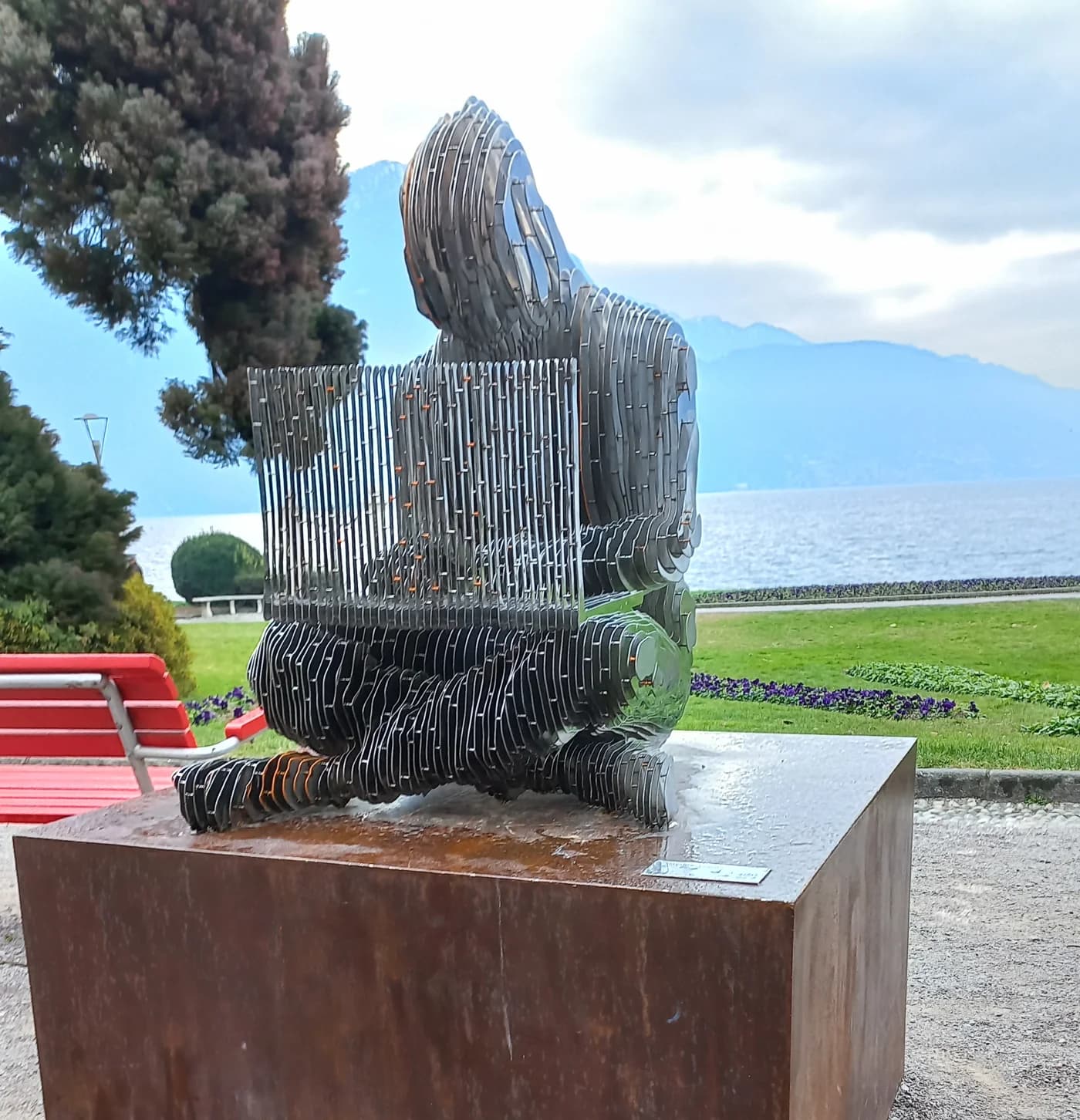
On 14 October a statue performing the same trick will be unveiled in Vienna's Viertel Zwei: Satoshi Nakamoto as a seated figure with a laptop, made of 61 thin layers of stainless steel with narrow gaps, clearly visible from the side, almost invisible from the front. It was paid for by companies and 121 private donors through a collection run by Bitcoin Austria. It is celebrated as a work by Valentina Picozzi. The form thus comes to the city whose physics it grew out of, and its inventor does not get a single word in the Viennese publicity.
Bitcoin artists have dreamt for years of rich Bitcoiners as patrons. Here the dream has come true, only in reverse.
The series
The first copy was unveiled on 25 October 2024 in front of the Villa Ciani in Lugano, at the forum of Plan ₿, which the City of Lugano runs together with Tether, the issuer of the dollar token USDT. Tether announced the statue on its own website as Picozzi's work. Since then it has been multiplied: 21 copies are planned, marketed as «21 Nodes», among them in El Zonte, Tokyo, Hanoi, New York and Vienna. According to Protos, the New York copy was installed at the stock exchange by the Tether-funded Twenty One Capital.
According to the Wall Street Journal, Picozzi is the wife of Giancarlo Devasini, Tether's chairman and, according to Forbes, probably its largest shareholder; she herself speaks of her husband in interviews. Forbes currently estimates Devasini's fortune at 89 billion dollars, 22nd in the world. A Bitcoin artist could hardly dream of a richer patron.
The installations are paid for from below. In Prague a Bitcoin community is collecting one bitcoin, plus money for fees, customs, shipping and installation, and advertises that the same statue already stands in Lugano, El Zonte, Tokyo and Hanoi. In Vienna more than 1.3 bitcoin came together, and a further 0.25 bitcoin is being collected for maintenance, insurance and repairs. Bitcoin Austria advertises the work as «one of only 21 artworks worldwide» using «a special layer technique». Where this technique comes from, the announcement does not say. Bitcoin Austria asked me for sponsorship as well; I did not take part.
Someone noticed all the same. On the day of the unveiling in Lugano, the French portal Bitcoin.fr wrote that the statue was designed «à la manière des œuvres de l'artiste Julian Voss-Andreae». That sentence never made it into the publicity for the series.
The inventor's account
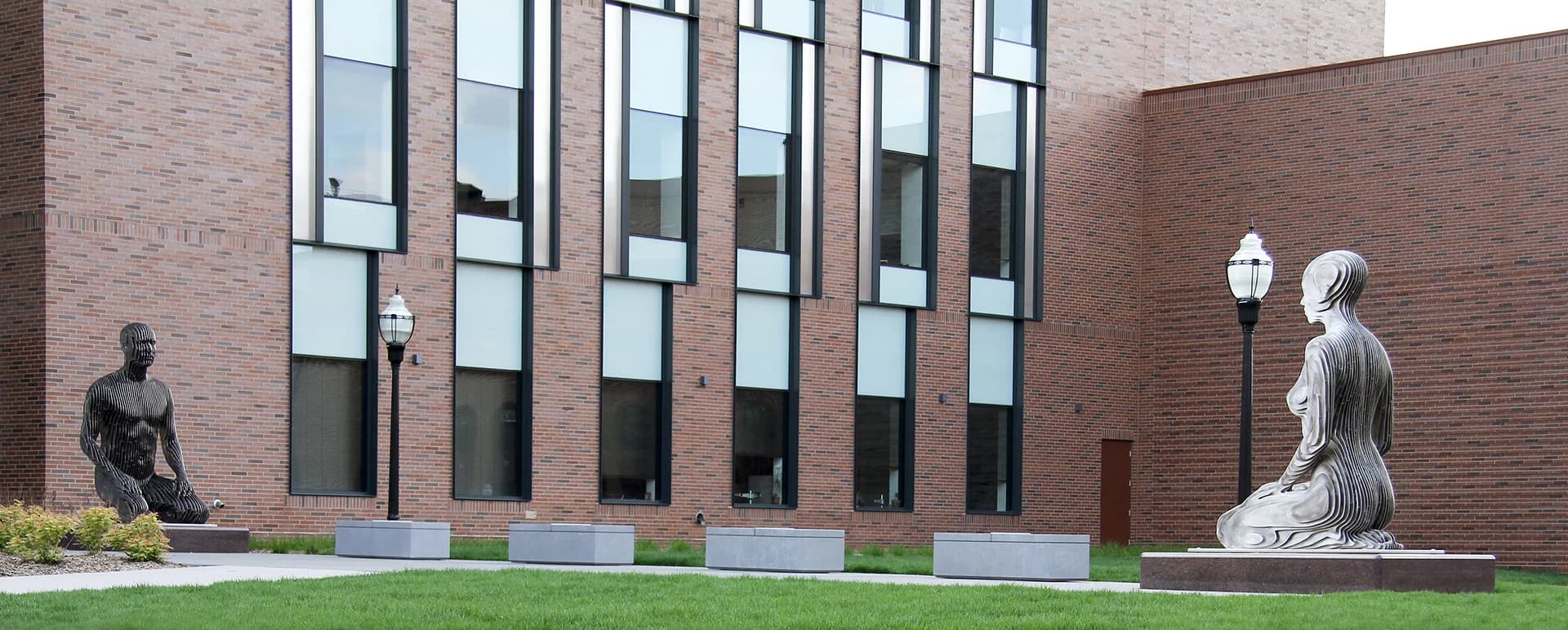
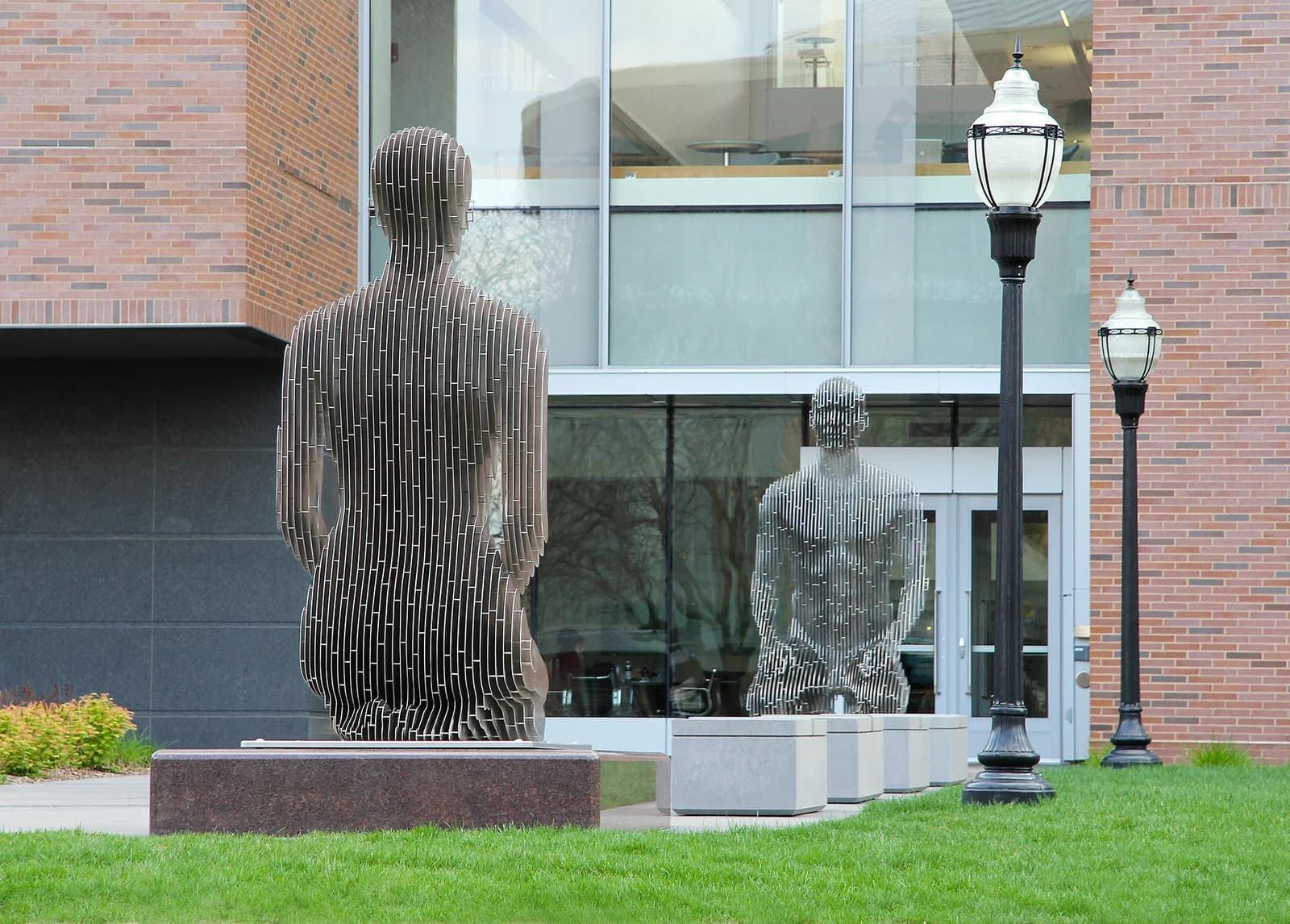
I asked Julian Voss-Andreae what he makes of the statue. His answer is unequivocal: he calls it a clear imitation, and clients, friends and gallerists who know his work see it the same way. He lists the correspondences one by one: the human figure, the seated or kneeling posture, parallel slices that give roughly one part steel to nine parts air in plan view, short pins each bridging one gap, of exactly the same diameter and length, arranged along the perimeter with the same distance and staggered spacing, and the same polish of the same stainless steel; the list goes on. He has made several kneeling and seated figures of this construction, for instance in 2014 in front of the physics building of the university in Minneapolis. Immediately after the unveiling in Lugano, several people wrote to him because they took the statue for his work, so extremely similar is it. The woman behind the statue, he says, is unfortunately not the only person he has «inspired» over the years; the quotation marks are his own. He has nothing against inspiration. But when someone does not name the actual originator and pretends to have invented something himself, that is very annoying and, for him, economically damaging; he took an enormous risk in building a career as an artist out of nothing. There was never any exchange, request or other contact with Picozzi, Satoshi Gallery or the man who executes the statues. And he is more precise than his imitators: unprompted, he names one or two artists who had done something similar before him and independently of him. Whether someone developed a form himself, he adds, can always be seen in the style.
The inventor names his predecessors, and his imitators do not even name him. He sent me one of these predecessors afterwards: «Akdeniz» by the Turkish sculptor İlhan Koman, erected in Istanbul in 1980, a woman with open arms made of 112 evenly spaced metal strips.
Patronage in reverse
Many Bitcoin artists hope for a rich Bitcoiner as a patron. The hope has a venerable precedent. The merchant money of the Medici made Florence the workshop of the Renaissance, and their posthumous fame rests on Donatello and Michelangelo, because a patron whose standing depends on the rank of his artists has to seek out the new before others recognise it. That is the economic core of patronage: the rich man bears the risk of the untried and pays for it, and the lustre of the work falls back on him.
Now a fortune of 89 billion dollars has found its way to Bitcoin art. This patronage did not have to look for anyone: the artist is the chairman's wife. What the circle around his company offers her is the most valuable thing the industry has to give, the stage in Lugano, the announcement on Tether's website, the copy at the New York Stock Exchange. The series is then paid for from below. The plebs, sincere and naive, collect one bitcoin here and 1.3 bitcoin there to give their city an imitation, and every copy installed advertises the next. That is patronage with the roles reversed. The small carry the costs, the great lends the lustre, and the glory that a patron otherwise buys with his money and his risk falls to his house for free.
What are the donors buying? It cannot be the form; someone else invented it, and a third party built the statue. What they pay for is the name of the series, the number 21, which flirts with the 21 million bitcoin, the list of cities where the same figure already stands, and a place in the shop window of a network that owns the biggest stages in the industry: belonging, in stainless steel. In Money Is for Strangers I counted most Bitcoin art as merch, the identity markers of the tribe, and there is nothing to be said against honest merch: whoever makes something himself and sells it at his stall contributes more than the speakers on the stages. The Satoshi statue is merch in monument format, and it lacks precisely what makes merch honest. Under the name it bears, it was neither invented nor made.
Without proof of work
Bitcoin rests on an incorruptible principle, proof of work. Whoever wants to add a block must burn energy and time, costs that nobody gets back; in this lies the network's connection to reality. In A Scholion on a Bitcoin Novel I described how the crypto world replaces proof of work with proof of luck. The statue honouring the man who made proof of work the foundation of a money carries out that replacement in stainless steel. Voss-Andreae found the form and worked it through over more than a decade, from «Quantum Man» in 2006 to «Isabelle» in 2018. The statues are built by a hobbyist who is good with his hands, and he credits Picozzi with the inspiration. The inspiration at issue here comes from a Viennese physics laboratory.
What remains is the idea of making Satoshi vanish in someone else's form. For an idea built on someone else's work, art history usually keeps a footnote; here there are 21 locations. Anyone who objects that the Old Masters had workshops too should read Rubens. In 1618 Rubens sent the English diplomat Dudley Carleton a list of the paintings he wanted to exchange for Carleton's antique sculptures, and noted for each how much of it was by his own hand; for the «Prometheus» he even recorded that the eagle had been painted by Frans Snyders. One picture that was not entirely his own, Carleton at first turned down. The great workshops did, however, declare who had done what, because that is exactly what buyers paid for. With the Satoshi statue the invention is borrowed, the hand belongs to someone else, and neither is declared.
Many Bitcoiners regard intellectual property as a fiction of the state. All the less excuse they have here. Whoever rejects patents and copyright keeps a single means of attributing inventions to their originators, and that is credit. Science manages with it and without courts, because reputation is the researcher's capital and citation its interest. For artists this holds even more sharply, since their income depends on commissions, and commissions follow the name. A public sculpture in Voss-Andreae's style that bears Picozzi's name diverts exactly this demand, and does so 21 times. Picozzi knows perfectly well how to credit a model: in an interview she traces her B-sign without fuss to Warhol's dollar sign. The dead Warhol she names; the living Voss-Andreae she does not.
That hardly anyone notices has a mechanism, which I described using the blurb of a novel. In the same scholion, a philosopher of resistance money certified the greatness of a book in which nobody resists anything, because Bitcoin was on the cover. The symbolism replaced the judgement, and with the statue it replaces it again: to celebrate it, one need not have compared it with any other sculpture; it is enough to know whom it depicts. A community sworn to «don't trust, verify», able to trace the provenance of every coin back to its minting, did not check the provenance of a form, although an image search would have sufficed and the name was in print on the day of the unveiling. Whoever finds a form of his own in this scene, sadly, goes to the back of the queue. Closeness to the symbol counts for more than invention, and closeness to money for more than both.
A quick grift
In Money Is for Strangers I described two failings of the Bitcoin scene that need each other. The LARP is sincere self-affirmation, life inside a certainty of salvation that only wants to be celebrated; the grift is its cynical twin, which lives off the faith of others. The Satoshi statue displays both in pure form. Whoever collects a bitcoin to raise a monument to the inventor of his own money raises it at the same time to his own conviction, and does not ask where the form comes from, because the form does not interest him; that is the LARP. Whoever serves this longing with someone else's design in series, has it built by another and paid for locally, while the husband's network provides the stages, is harvesting it. I call that a grift, and a quick one: an invention takes years, while its imitation can be rolled out in series across three continents.
Eight references
The white paper with which Satoshi Nakamoto presented Bitcoin in October 2008 has nine pages and eight references. The first goes to Wei Dai's «b-money», another to Adam Back's «Hashcash», three to papers on digital time-stamping in which Stuart Haber and Scott Stornetta had a hand. A pseudonym that could gain neither reputation nor career from citations named its predecessors when nobody could force it to, and then vanished. That vanishing is what the statue celebrates: it honours the man who renounced fame and conscientiously allotted it to others with a work that withholds the fame of the inventor, and the share of the man who built it as well.
An honest plaque beside the Vienna statue names the inventor of the form, the hobbyist who built it, and in third place the woman who had the idea of making Satoshi vanish within it. In Bitcoin, every block proves publicly that work was done; with the statue that honours Bitcoin's inventor, the publicity keeps quiet about whose work went into it.
Sources
Statue and series: Tether, announcement of the unveiling in Lugano, 25 October 2024; Bitcoin Austria, work page and fundraising appeal, in German, accessed 9 October 2026; Prague location initiative by Jednadvacet.org. Valentina Picozzi and Tether: Protos, The family affairs shaping Tether's $180B empire, 15 December 2025, citing the Wall Street Journal and the Financial Times; Forbes, Giancarlo Devasini, real-time estimate of 9 October 2026; Atlas21, Narrating Bitcoin through art, 22 February 2024. Julian Voss-Andreae: Science, Newsmakers, 18 August 2006, p. 913; Julian Voss-Andreae, Quantum Sculpture: Art Inspired by the Deeper Nature of Reality, Leonardo 44 (2011), no. 1, pp. 14 to 20; Isabelle, Palm Springs 2018; Bitcoin.fr, Forum Plan ₿ à Lugano, 25 October 2024. Julian Voss-Andreae, personal communication to the author, 9 October 2026, quoted with his consent. Execution of the statues: author's knowledge. İlhan Koman, Akdeniz), Istanbul 1980. Images: Satoshi statue in Lugano, photo by Martin Thurnherr, CC BY-SA 4.0, Wikimedia Commons, cropped and resized, the crop likewise under CC BY-SA 4.0; «Spannungsfeld» (2014), two photographs, © Julian Voss-Andreae, with his permission. Rubens to Sir Dudley Carleton, 28 April 1618, after Sotheby's, The Lion Hunt, 2023 and the Oldenburg gallery catalogue («Originale di mia mano, et l'aquila fatta dal Snyders»). Satoshi Nakamoto, Bitcoin: A Peer-to-Peer Electronic Cash System, 2008.
Rahim Taghizadegan is the last Austrian representative of the Austrian School in the direct tradition, entrepreneur, author of more than fifteen books, university lecturer, and the founder of scholarium, citadel.garden, and deedsats.
The Scholien newsletter
Scholien. Monthly marginal notes by Rahim Taghizadegan on the present, written in the mode of the Viennese school.
Monthly. Unsubscribe with every issue.