
A Scholion on a Bitcoin Novel
Tibor Fischer's «My Bags Are Big», the Houellebecq question and the difference between Bitcoin and crypto
Tibor Fischer opens his new novel with a line of Latin, «O quantum est in rebus inane», how much emptiness there is in things. It is the first line of Persius's Satires. Fischer gives it to Lucilius, and he's right. The only reason we know is an ancient reader's note in the margin of Persius, saying the line came from the first book of Lucilius. Such notes are called scholia, hence the name of this series. So the motto is borrowed. It is also the most accurate sentence in the book. Fischer sent me the novel from Budapest with a note that it was partly about Bitcoin and might amuse me. The Bitcoin part is what I deal with here.
The novel
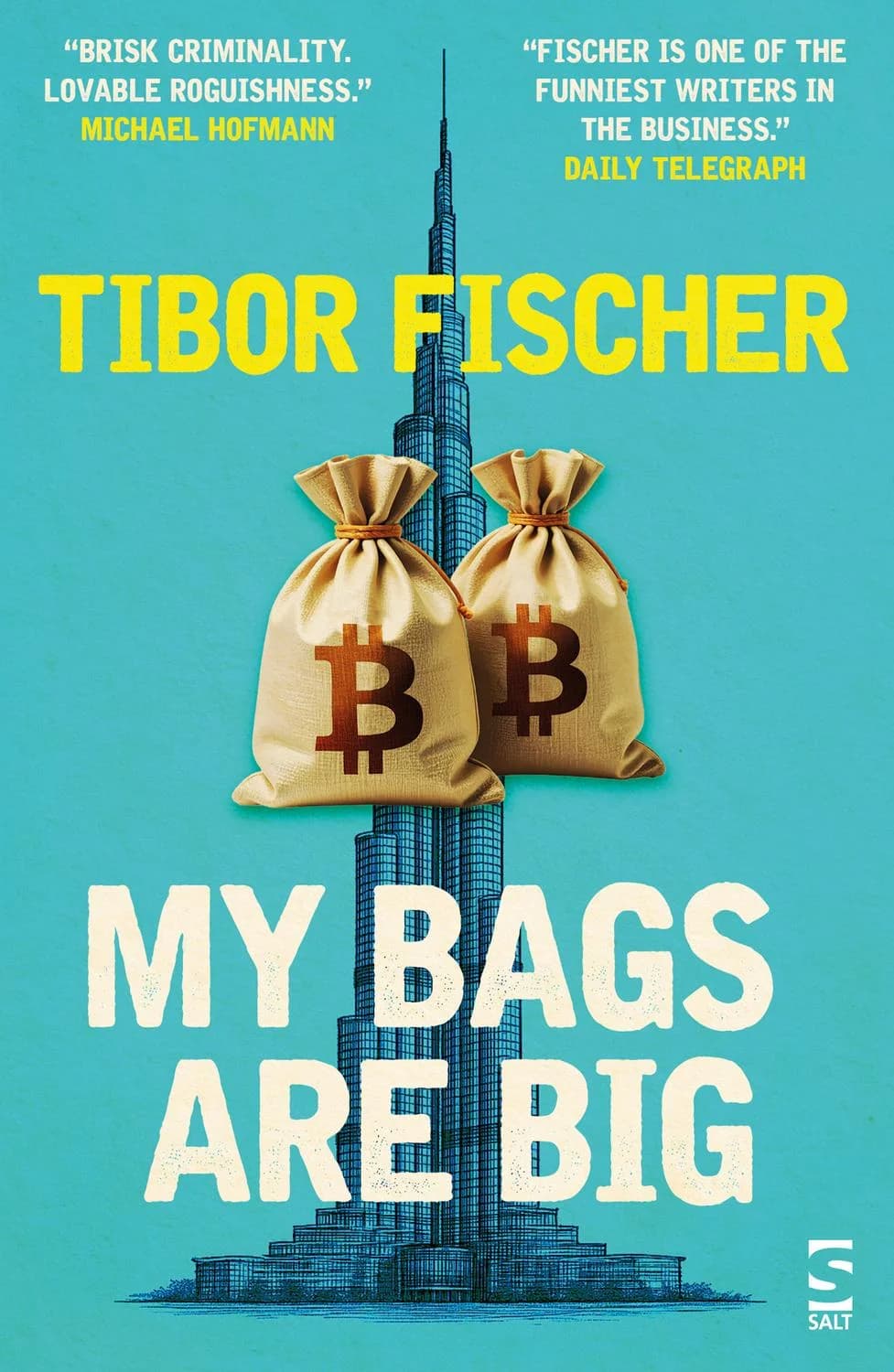
«My Bags Are Big» came out in February with Salt, a small press in Norfolk. The cover has two money bags with the Bitcoin sign on them, hanging in front of the Burj Khalifa, which the narrator calls the biggest phallic symbol on earth. Fischer was born in 1959, the son of two Hungarian basketball players who left Hungary in 1956. His first novel, «Under the Frog», was turned down by 62 publishers, came out in 1992 and was shortlisted for the Booker in 1993; that same year Granta named him one of the 20 best young British novelists. «The Thought Gang» (1994), in which a philosopher takes up bank robbery, is one of the funniest books of the nineties. Fischer can be savage, too. His 2003 review of Martin Amis's «Yellow Dog» is still quoted. The early books came out with big publishers. This one didn't.
The narrator, Dan, is sixty and from Catford in south London. His agency looked after tennis players ranked in the six hundreds; he nursed his mother and buried his wife. One sleepless night in 2016 he watched some nutter on television promise that Bitcoin would make the banks cry, and soon after he fed a twenty-pound note into a Bitcoin machine in a café on Old Street. Now he lives in Dubai on his «bags», which is what the scene calls its holdings. There isn't much plot. There's an old flame and her daughter, a crypto whale called Bigger with a gold safe, a Catford gangster with a pink boulder, and at the end a laptop full of Bitcoin that changed hands in a pub years ago for a few pounds. Sections open with the price (six cents, three thousand dollars, thirty thousand), so the price serves as the calendar of Dan's life.
British critics liked the jokes, and The Spectator called Fischer a very British Houellebecq. On the cover the philosopher Andrew M. Bailey calls it the first great Bitcoin novel; the writer and editor Daniel Johnson calls it the crypto novel. Only one of them can be right, and the answer says more about the Bitcoin scene than about Fischer.
A British Houellebecq?
In «Whatever», his first novel, Michel Houellebecq already treated love as a market. Some people get plenty of it, others none, and the losers go under. In «The Possibility of an Island» a rich comedian named Daniel admits he got rich by exploiting base instincts. In the Scholien of 2009 and 2010 I called Houellebecq's books documents of participant observation, to be read against the grain so the nihilism doesn't rub off.
Dan is Daniel without the confession. He has nearly the same name, made a fortune out of nothing as well, and sizes up women like positions in a portfolio. Where Houellebecq's men suffer from the market, Dan loves it, and he thinks it fair. Crypto, as he sees it, is a lift that takes everyone up, taxi drivers and nail technicians and dog groomers included. A couple of semi-nerds can launch a token with a cartoon frog over a weekend and walk off with a fortune, while engineers who put in years get trampled. Dan won by chance and calls it achievement, and he doesn't understand the market he enjoys. The Spectator's comparison flatters the Briton and wrongs the Frenchman.
Bitcoin and crypto
After FTX collapsed I explained in a newspaper article why bankers and regulators find Bitcoin so boring. It's a program. There is no operator and no board to invite, advise or supervise, and the financial industry finds that maddening. So it built crypto next to it, with exchanges, tokens, conferences and price screens, a stage where regulators, financiers and influencers all feel at home. Fischer's novel only knows that second world. Bitcoin appears as a price, as bags, as a chart for technical analysis, as a counter on the wall at a party on the sixtieth floor. Hayek gets a single mention, as a name in a young Brit's sales patter, somewhere between staking and the metaverse.
The props of monetary history are decoration. Ming, the surgeon who first told Dan about Bitcoin, has a stone wheel from Yap in his driveway. Stones like that were money on the island, and textbooks love them because a stone could change owner without being moved; the whole island simply remembered whose it was. That is a shared ledger centuries before computers, which is the idea behind Bitcoin. In the novel it's a garden ornament and a crypto joke. Bigger, the whale, has his guests guess what is inside his gold safe. It turns out to be a comic from his childhood. Glitter outside, nostalgia inside. Crypto works the same way.
Proof of luck
The one principle that sets Bitcoin apart does come up, as a party line. Genius is just hard work, Dan says; proof of work. In Bitcoin, proof of work is how blocks get added. You have to spend electricity and time on a computation that can't be faked, and that cost is what anchors the network in the real world. Fischer's characters run on proof of luck instead. Bigger's fortune comes from a laptop bought in a pub, Dan's from a twenty-pound note, the frog token's from a weekend.
Dan draws his conclusions with a cynic's candour. Crypto now moves in step with the stock market. The problem with crypto is the people. And the line he is proudest of: "Bitcoin has helped a few humans, not humanity." About crypto he is right every time, since that is what the last bull market made of a money designed for strangers. He misses Bitcoin itself, which doesn't need anyone's good opinion, not even its holders'.
The blurb
So Johnson is right, it's the crypto novel, and Bailey's endorsement tells you more about the scene than about the book. Andrew M. Bailey co-wrote «Resistance Money», a philosophical defence of Bitcoin as money that resists state control, and he is a senior fellow at an institute that advises lawmakers on Bitcoin. A philosopher of resistance money certifies the greatness of a novel in which nobody resists anything. You don't have to read the book to write a sentence like that. You only need to know that Bitcoin is on the cover and that the scene could use a novel; the symbol replaces the judgement.
In Money Is for Strangers I called this the disease beneath the symptoms. Most of what gets written about Bitcoin is self-congratulation, and the authors vouch for each other as podcast guests, panel neighbours and blurb writers. This time the circle closes on a book cover, around a book that holds the scene up to ridicule.
The dealer
Bitcoin does what it was built for exactly once in the book. A dealer facing prison moves his cash into Bitcoin, where the police can neither seize nor trace it; back then, Fischer jokes, they knew about as much about crypto as about the Sunday bus timetable in Jakarta. Three years later he walks out, the price has soared, and he buys himself a country mansion. A fortune no authority can seize and no custodian can lose, held for years without permission and without a counterparty, is exactly what Bitcoin is for. Money is for strangers, in the limiting case for enemies, and here the limiting case is a criminal. Fischer gives it half a page as a villain's anecdote. It is the only place where his novel is really about Bitcoin.
Even so, the novel catches the truth about the last cycle, against its own intent. In Money Is for Strangers I described two failings that feed each other: the LARP, the believers' sincere self-affirmation, and the grift, the cynical exploitation of that belief. Fischer's characters are pure specimens of both. Bigger, pumping memecoins and running a guessing game around his safe, is the grift. Dan mistook a rising curve for the end of scarcity and now sits on his bags, tired and sated, like a dragon on its gold; he is the LARP. The book is set in 2023, with Bitcoin stuck around thirty thousand dollars, and it came out in a bear market, far below the high of the year before. It's a snapshot of what the cycle did to Bitcoin, taken by someone who takes the snapshot for the whole picture.
The missing crime
What the novel leaves out is what lies closest to its author. Fischer's parents left Hungary in 1956. Anyone who was an adult there ten years earlier had lived through the end of the pengő, the fastest collapse of a currency on record; in July 1946 prices were doubling roughly every fifteen hours. Inflation doesn't appear in the book. Dan's father ran a bookie's in Catford and carried a cosh to work, and every year a third party quietly helped itself to part of his savings, with no violence and no anecdote. Bitcoin was made against exactly this silent theft, as the first money whose supply nobody can increase. The novel never mentions it, and Dan wanders off to the canapés, as he does after every thought. A Bitcoin novel without inflation is a crime novel with the crime left out.
The only theory in the book is the wheel of fortune, and for crypto it holds: most people who got rich in the bull market did so by luck and have called it merit ever since. Dan's verdict on his own life is that he can't win, he can only stall. That is the verdict of a man who has spent his life in zero-sum games, on the tennis court, in his father's betting shop, in Dubai, and who mistakes the one positive-sum game he stumbled into for a lottery. Exchange is the other world history, and it is as absent from the book as inflation. Bitcoin doesn't ask whether its holders earned their luck, which is why, among fortune hunters, it looks as dull as proof of work. Dan comes close to saying so himself: dull has its uses. He just doesn't know which ones. Fischer did at least borrow his best line, like Persius, from an older writer. Sadly it stayed the only one.
Sources
Tibor Fischer, My Bags Are Big, Salt Publishing, Cromer 2026, ISBN 978-1-78463-385-1; cover endorsements by Andrew M. Bailey, Daniel Johnson and Michael Hofmann. Cover image: Salt Publishing, from the reading copy sent by the author. Reviews: Ian Sansom, The Spectator, March 2026; Houman Barekat, The Guardian, 28 February 2026; Kyle Wyatt, Times Literary Supplement. Biography: Hungarian Review, author profile; Granta 1993; The Daily Telegraph, review of Martin Amis's «Yellow Dog», 2003. Persius, Saturae 1.1; the ancient scholion notes: hunc versum de Lucili primo transtulit. Michel Houellebecq: Scholien 03/2009 and 01/2010 (Institut für Wertewirtschaft, in German); Whatever (Extension du domaine de la lutte, 1994); The Possibility of an Island (La possibilité d'une île, 2005). Andrew M. Bailey, Bradley Rettler, Craig Warmke: Resistance Money, Routledge 2024. Bitcoin and crypto: «FTX: Regulierungsillusionen und Finanzblähungen», Finanz und Wirtschaft. Self-congratulation, LARP and grift: «Money Is for Strangers», scholarium.at, 2026. Pengő: prices doubling roughly every 15 hours at the last, July 1946. Bitcoin price: high of 126,198 USD on 6 October 2025; 79,524 USD on 9 September 2026.
Rahim Taghizadegan is the last Austrian representative of the Austrian School in the direct tradition, entrepreneur, author of more than fifteen books, university lecturer, and the founder of scholarium, citadel.garden, and deedsats.
The Scholien newsletter
Scholien. Monthly marginal notes by Rahim Taghizadegan on the present, written in the mode of the Viennese school.
Monthly. Unsubscribe with every issue.