
Making an Example of the Prince
From the Captain of Köpenick to Prince Reuss: what the first interview from prison reveals about the Reichsbürger, QAnon, grift and the asymmetry of statism
On 16 October it will be 120 years since a performance that Carl Zuckmayer later called «a German fairy tale». Wilhelm Voigt, an unemployed shoemaker, had put together a captain's uniform from second-hand dealers. Wearing it, he took command of a squad of Guards soldiers, occupied the town hall of Köpenick, had the mayor arrested and the municipal treasury seized. What he was actually after was a passport; the authorities had been refusing him one for years. No one asked to see his orders, since the uniform did the job. He got four years, was pardoned by the Kaiser after twenty months, and much of the world had a good laugh at Prussians who would obey any uniform. The Empire was confident enough to join in.
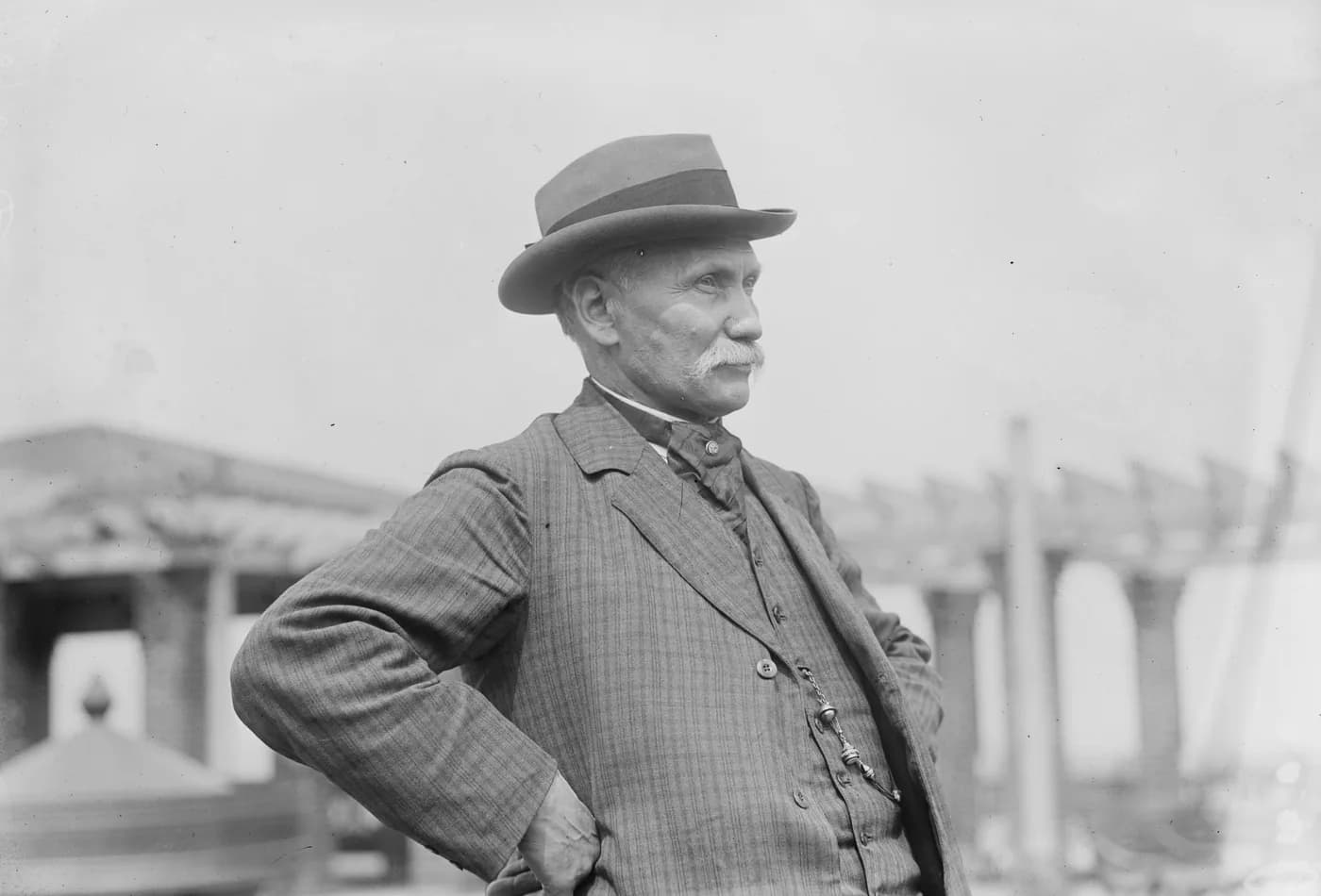
Heinrich XIII Prince Reuss, who wanted to restore two principalities of that empire, has been held in pre-trial detention in Frankfurt since December 2022. This will be his fifth Christmas in a cell, and after almost four years there is still no verdict. On 12 October Roland Tichy published the first interview with him. Making an example of Reuss is a sign of how nervous the German state has become, precisely because the loss of trust it is aimed at is entirely justified. An example singles one person out of the crowd so that the crowd will look, which is why the thousands of comments in support of Reuss matter: they make the example plainer still. A day after publication there were about 2,500 of them, on 336,000 views. The most liked, each with more than a thousand approvals, speak of «state terror» and a «political prisoner», or simply note: «And violent criminals walk free.» Even those who call Reuss a crank demand his release.
What the prince believes
In the interview we meet a polite, rather rambling man in his mid-seventies, an engineer by training and a property developer by trade, who wandered into a world he has never entirely left. From 2018 onwards, he says, he heard of an «Earth Alliance», an «appendix of a cosmic federation» that had formed after the Kennedy assassination to fight the «Deep State» and wanted to restore sovereign states all over the world, beginning with Germany. The takeover was supposed to come during the NATO exercise Defender 2020; later the messages announced solar eruptions and power cuts. Because he could not let go of the stories of children ritually abused in underground facilities, he gave 50,000 euros for their liberation. The pyramids in his garden «do quite a lot», he says; that is simply a different physics, one not yet understood. Today he calls the Earth Alliance «disinformation terrorism» that «seems to be a business». So he has seen through the fraud, yet he still believes in child abuse in political circles, in the continued force of the Hague Regulations on land warfare and in the enemy-state clauses of the UN Charter, and concludes that every land register would be void, his own included. He himself, he says, merely kept an open house where people talked about everything.
I consider Reuss a harmless LARPer. The abbreviation stands for live action role play, role play in costume and on a set. The Reichsbürger, Germany's self-declared «citizens of the Reich», play at being a state: they issue identity papers, found councils, award decorations and submit proclamations. In the summer of 2021 Reuss wanted to hand Vladimir Putin, at the economic forum in St Petersburg, the proclamation of two restored principalities of Reuss; by his own account he was not allowed to fly. That too was role play, with world politics as the backdrop. After 32 years of fighting over his family's estates, a man may find the line between legal files and make-believe harder to draw than most of us.
Whoever believes nothing
The German state gave plenty of reasons for this loss of trust in the pandemic years, and it met the distrust with surveillance: since 2021 its domestic intelligence service has kept a category of its own for the «delegitimisation of the state relevant to the protection of the constitution». A state that needs its domestic intelligence service to guard its legitimacy knows best how matters stand with it. Unfortunately, justified distrust makes nobody wiser, and Chesterton knew why. In «The Oracle of the Dog» he has Father Brown say that the first effect of not believing in God is to lose your common sense and no longer see things as they are; from this came the familiar saying that whoever believes in nothing will believe in anything. Someone who no longer believes a word of the evening news believes an email from unknown senders claiming that soldiers had freed more than 600 children in three days and were now moving on to the Memel region. This loss of a sense of reality has nothing to do with education. At the prince's table sat a judge who had been a member of the Bundestag, along with doctors, lawyers and businessmen. In a 2022 survey, one German in eight agreed at least in part with central QAnon narratives.
That is why the authorities' fear is justified as well. A LARP becomes dangerous as soon as the players lose their sense of reality and forget that they are playing, and in the prince's circle not everyone had kept it. More than 380 firearms and almost 150,000 pieces of ammunition were seized in the network; former soldiers are alleged to have set up «home guard companies» that were to carry out political purges after the coup, and according to the indictment the former member of parliament guided co-defendants through the Bundestag to reconnoitre it. When a special police unit searched a flat in Reutlingen in connection with the case in March 2023, the occupant shot and wounded an officer. The circle, then, was not quite as harmless as its host, and Reuss let himself be used precisely because of his credulity. The members of his council, he says, were brought to him by others; a prince is rather handy, a joker one can push to the front.
Grift and role play
The joker's part has an economic core. Grift, or more precisely an «affinity scam», is a swindle that exploits ideological or personal closeness, that is, belonging to a feigned «we». The grifter says: I am one of you. Role players and grifters need each other, because the one supplies the faith and the other keeps the till; that this pair unfortunately also thrives on the fringes of Bitcoin I have described in Money Is for Strangers. According to Reuss, confidentiality declarations bearing the initials «PR» for Prinz Reuss were handed out at demonstrations, where the same people sold forged vaccination certificates and supposed government bonds. One of his co-defendants cashed in his life insurance for the child rescue, and in all up to 500,000 euros are said to have changed hands. Reuss was among those who gave; he says he learned of the business others were doing in his name only from visitors and in the course of the trial.
Peter Fitzek plays the other part in this piece. A former karate teacher, he had himself crowned King of Germany in Wittenberg in 2012 and ran the kingdom like a firm: it issued its own ID cards, ran a bank and a health insurance scheme, and bought land with its subjects' money. Voigt had wanted a passport from the state; Fitzek printed his own and sold them. Federal prosecutors say he never paid VAT on some ten million euros of revenue. The kingdom survived for thirteen years, with interruptions for trials over unlicensed banking, until the interior ministry banned it in May 2025; Fitzek has been in custody since, charged as ringleader of a criminal organisation. Reuss, who lost 50,000 euros, stands accused of leading a terrorist organisation and of preparing high treason.
The case of QAnon, from whose narrative world the Earth Alliance comes, is clearer still. Conspiracies exist, of course; it would be the dumbest of all conspiracy theories to deny it. A suspicion becomes a conspiracy narrative only when someone fails to understand a dynamic and therefore needs a hand on the levers. When media, parties and officials all say the same thing, the believer concludes that a degenerate elite has agreed to cover up its crimes, and when that elite falls, it can only be because a good alliance brought it down. The German edition throws in the Kaiser's Reich, a few principalities and the peace treaty that was never signed. The prosecution, oddly enough, needs a mastermind just as badly. A loose milieu of con men, believers and ex-soldiers that drifted together does not fit well into a trial that requires a ringleader, and Reuss keeps insisting that as an engineer he is a man of plans and that there was no plan. Under the video, meanwhile, more than a hundred people endorse the idea that it was all a sinister intelligence plot.
Q was a business from day one. In 2022 two independent stylometric studies identified the probable authors of the Q drops: a South African programmer and Ron Watkins, who administered the very message board whose traffic came mostly from Q believers. Both deny it. The early promoters lived off donations and subscriptions, and a whole industry grew up around the story, merchandise included. None of them has been charged; Watkins even ran for Congress in 2022. Whoever invented QAnon and made massive commercial profits from it, the grifter, that is, still walks free, while the harmless LARPer who paid for the faith has been in custody for nearly four years.
German idealism
The interview is most revealing where Reuss speaks about himself. He never worked for himself, he says; he is merely «a link in the chain». He cannot understand why nobody grasps that a man might act «selflessly», and the court cannot get its head round it either. His house has «no rights at all any more», only «duties arising from our structure». In the House of Reuss every son has been called Heinrich since the Middle Ages, told apart only by an ordinal number. A man who sees himself as the number of a higher whole that alone holds rights and dignity is the typical creature of German idealism. For Fichte this whole was the nation, for Hegel the state; for the Reichsbürger it is the Reich, which lives on as an idea although nobody has administered it in reality for a long time.
The German state itself, however, supplied him with this idea. In 1973 the Federal Constitutional Court ruled that the German Reich continued to exist and retained legal capacity, but was unable to act «for lack of organisation». A Reich that exists only on paper is idealism in its purest form, and the Reichsbürger simply takes the judges at their word, skipping the part where they declared the Federal Republic identical with that same Reich. He is nostalgic for the state; to him the Federal Republic is not state enough. What he wants is an older, fuller state with princes, estates and a peace treaty, which has little to do with any scepticism about the state.
With this comes an elitism that appeals to blood. The families of the ruling houses carry a «DNA» from the high cultures, Reuss explains, a sort of «DNA tuning»; the zebra recognises the zebra and the horse the horse. In his case of all people, a genetic claim to leadership is absurd. On his father's side he descends from the cadet line of Reuss-Köstritz, which never ruled. The blood of the ruling line of Reuss-Gera came through his mother, and under the house law no claim passed through women. What links him to the last hereditary prince of that line, whom he calls his «grandfather murdered by the Russians», is an adoption of his father that settled the inheritance and not the succession within the house. The senior line died out in 1927 with a prince whose disability meant he never actually governed. The House of Reuss had already distanced itself from its headstrong relative before the arrest. What Reuss calls heredity is legal history, and it was legal history that saddled him with the duties to which he gave up his life, chasing a restitution from which he himself would never have benefited. He is serious about this selflessness, and it made him easy prey: someone who pays on behalf of a higher whole is slow to ask for receipts.
The asymmetry of statism
Prosecuting this milieu makes sense in principle. A monopoly of violence, once challenged, always tends in a cold civil war towards excessive force and towards making examples. Around 3,000 officers took part in the December 2022 raid; trials followed in three cities against more than two dozen defendants. Section 129a of the Criminal Code, introduced in 1976 against the Red Army Faction and its murders, is now being used against a discussion circle that brought together gun owners, soldiers and role players. It makes an association punishable once its purpose is directed at crimes, and with a host who mixes up the law of war, outer space and child rescue, that early stage creeps uncomfortably close to the regulars' table in a pub.
It is the yardstick, which of course is wrong, that reveals the asymmetry of statism. When it comes to the safety of citizens, the state is never as thorough as when it comes to the safety of its own henchmen, all platitudes about equality notwithstanding. Anis Amri came up six times at the Joint Counter-Terrorism Centre in 2016 and was on the list of known threats; nobody stopped him before he killed twelve people at the Christmas market on Breitscheidplatz. A minister's honour, on the other hand, was worth an early-morning police search of a pensioner's home in 2024, in part because he had called the minister a «Schwachkopf», a nitwit, on X. Since 2021 Section 188 has protected politicians, down to local councillors, more strictly against insult than the people who vote for them. In the same spirit, the king who took millions from his followers is treated as a criminal, and the prince at whose table people talked of a coup as a terrorist.
The comments beneath the interview show that this example reaches its audience, though not as intended. Most see injustice in it, some already the proof that there must be something to the prince's stories; one asks how close this man must have come to the truth if he has been locked up for four years for it. In this way the state's severity confirms the very suspicion it is aimed at. At least the interview has laid bare the core of the matter: a credulous old man gave money to fraudsters and discussed with his guests what to do if an alliance from outer space overthrew the government. The empire could still laugh about its false captain. A state that sees a traitor in this prince betrays its nervousness, and it is nervous because it knows how well founded its audience's distrust is.
Rahim Taghizadegan is the last Austrian representative of the Austrian School in the direct tradition, entrepreneur, author of more than fifteen books, university lecturer, and the founder of scholarium, citadel.garden, and deedsats.
The Scholien newsletter
Scholien. Monthly marginal notes by Rahim Taghizadegan on the present, written in the mode of the Viennese school.
Monthly. Unsubscribe with every issue.