
Bitcoin Is Dead Again
An assessment after the autumn of hacks: declining judgement, treasury companies without a business, and a commons that nobody carries any more.
The essay read aloud, 49 minutes.
Fear of hacks is currently running very high in the «internet of money». Hardly had the self-custodians recovered in the summer from the shock over their signing devices when a sidechain lost its reserve, then the largest exchanges were plundered, and the next piece of bad news could arrive any day. By the verdict of retail investors and experts alike, Bitcoin ought to have died again long ago; according to bitcoindeaths.com it has been declared dead 482 times since 2010, 28 times in this year alone. The mood is as foul as during earlier shock corrections, for instance after the collapse of Mt. Gox, after which I lost all interest in Bitcoin for several years.
This time, however, something else comes on top, and it troubles me more than any price crash. Blows are raining down from outside, and inside much has gone to seed. I have already held forth on the role-play, the self-congratulation and the cynicism of the last cycle in «Money is for strangers», and I need not repeat myself. Back then it was still about vanities; now it is getting serious.
Scholia by email · since 2009
Scholia. Monthly marginal notes by Rahim Taghizadegan on the present, written in the mode of the Viennese school.
One issue a month. Your address is never passed on; unsubscribe with every issue.
Canary, magnet and shield
As the last international bearer instrument in the world, Bitcoin is in fact freely transferable, and therefore also direct prey for attackers. A bank can reverse a booking, a court can correct a register; with Bitcoin, what is gone is gone. Bitcoin is therefore the canary in the coal mine: what would go undetected for years in a bank may cost someone his savings here on the same evening. Bitcoin is a magnet for attacks and thus potentially even a shield, because it drew to itself so much attacking energy that would otherwise probably have struck other infrastructure. With AI this becomes sharper still, because AI makes finding vulnerabilities and deceiving employees cheaper.
In the summer the wave reached Bitcoin. Older Coldcards, signing devices for cautious self-custodians, had been generating poor random numbers since 2021, and over 1,800 bitcoin were stolen with computed keys. In September the sidechain Liquid, because of a validation error, released around 4,000 bitcoin from its reserve, most of which came back the next day. Then Bitget was hit, and at the end of October Binance, where the perpetrators got as far as the signing processes via developer machines and even an in-house AI tool; holdings of $6.34 billion were affected, and by the beginning of November just under half had been frozen or intercepted.
For those affected this was dramatic. The network itself was not touched, and this distinction is what matters to me: what was hacked were keys, a separate chain and the signing environment of exchanges, while the Bitcoin main chain merely executed what arrived at it with a valid signature. The main chain does exactly that for the thief as well. Of course Bitcoin owners thereby bear a technical risk, only that risk lies in the lock on the safe and hardly in the metal. That the exchange break-ins hit so many people has a reason to which I will return: more and more investors hold their bitcoin as a claim against exchanges, funds and listed companies, and where many keep their holdings at the same few places, a single error there suffices.
That the network has so far succumbed to no attack is astonishing. This antifragility is, as always, the strongest argument for Bitcoin, not its features and not the «selling points», which are different in every cycle. Bitcoin has also survived its own early teething troubles, the inflation bug of 2010 and the unintended chain split of 2013, and with Coldcard there was even a gain in knowledge: the flaw was found, and the fix has since been reviewed independently.
What the buyers still pay
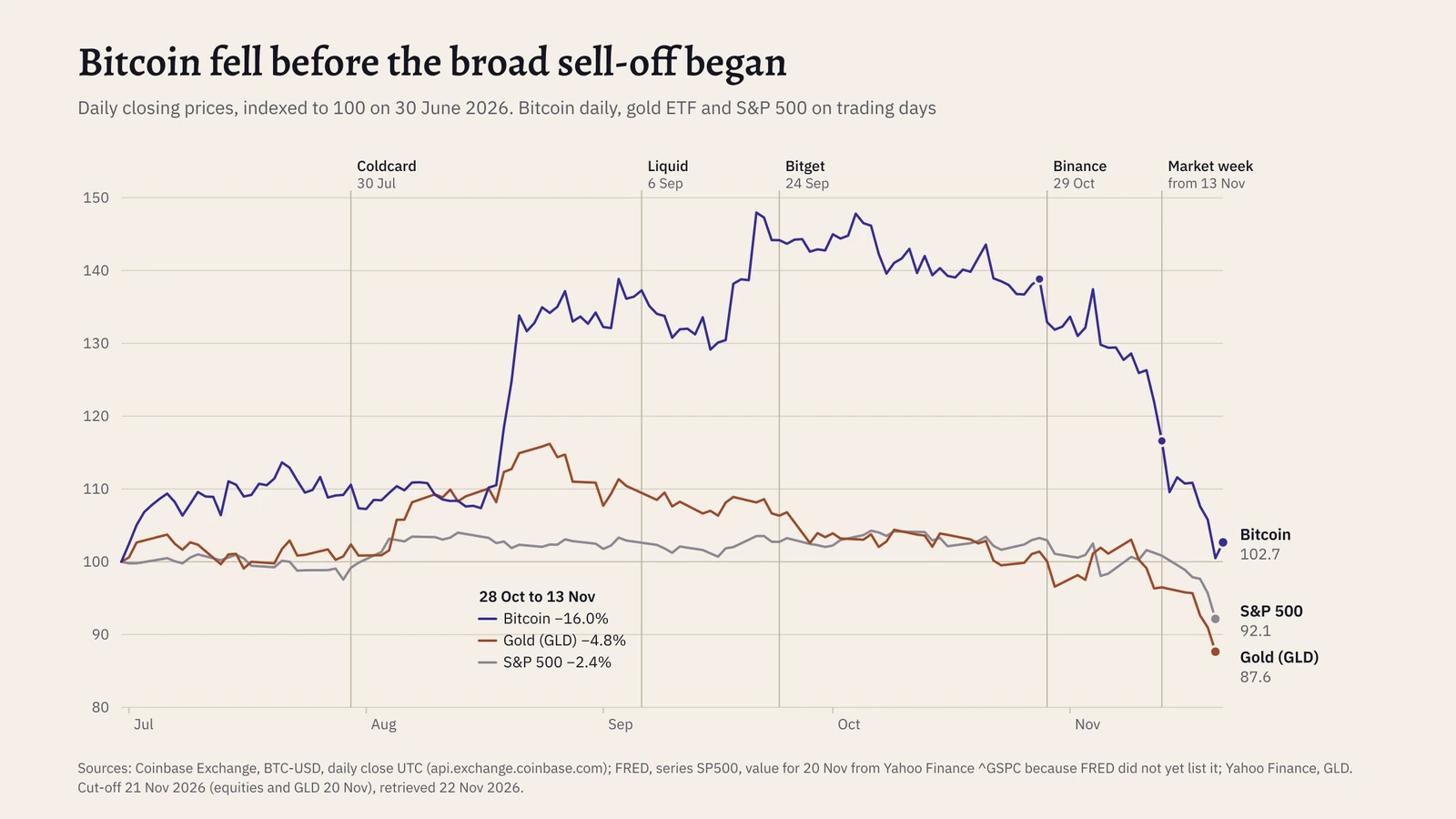
The price showed the second antifragility. During this catastrophic wave of attacks, which massively shook users' confidence, the relatively stable and high price was the weightiest argument for Bitcoin. At the end of June Bitcoin stood at around $58,500; at the end of September, after Coldcard, Liquid and Bitget, at over $84,000. The self-custodians doubted their devices, and the price rose strongly all the same.
The price gave way only after Binance, by around 16 percent to mid-November, and then, in the sell-off of practically all assets, by just under 14 percent more. The first part of the decline was thus home-made, the second came from outside. In the week to 20 November the American stock indices lost between 8.6 and 10 percent, and even gold fell by just over nine. Only dollars and long-dated American government bonds were in demand, and the yield on the ten-year fell from 5.15 to 4.92 percent. I read this as the expectation of a deflationary shock, even though inflation has by no means disappeared: the war between the USA and Iran is making energy more expensive, consumer prices still rose by 0.4 percent in October, and the labour market created 165,000 jobs. But inflation expectations fell markedly, among American households from 4.7 to 3.7 percent within a month. In a situation like this, what gets sold first is whatever can be turned into dollars fastest, and Bitcoin and gold act as early warnings of volatility, simply because selling them is possible. On Sunday, 22 November, a bitcoin again cost around $60,000, less than half the record of just over $126,000 in October 2025. All the same, the price is surprisingly high, measured against the demand I would have expected after such a chain of hacks, war and fear for liquidity.
Every scarcity can be hacked
Nor did the physical offer any refuge this autumn; gold and silver corrected sharply. And even if metal cannot be hacked like a key, gold too can be «hacked». That other elements can be turned into gold has been proven since 1980, when physicists in Berkeley turned bismuth into gold in a particle accelerator, albeit at absurd cost. Today the company Marathon Fusion calculates that future fusion power plants could turn mercury into gold as a by-product, about two tonnes per gigawatt per year, against world production of just over 3,600 tonnes. This is still unreviewed and a matter for the future, yet the gold holder would already be hit by the first credible price for one additional tonne a year. In space it is similar, only further off: NASA's Psyche probe will reach its metal asteroid only in 2029, and nobody knows whether ore can ever be brought back at a saleable price. Monetary history, however, is full of supply shocks from new processes, from Potosí to the Witwatersrand. In 1884 the Washington Monument was still crowned with aluminium, which at the time was twice as expensive as silver, before electrolysis made aluminium a mass metal two years later.
Diamonds have already been hacked. Laboratory stones can hardly be told apart from natural stones any more, a one-carat lab diamond costs around 96 percent less at wholesale than in 2018, and in the USA in 2025, 61 percent of new engagement rings already carried a lab stone. Whoever sets store by provenance still pays a premium; whoever simply wants a beautiful diamond no longer needs a mine. Even De Beers gave up its lab brand, and this year it realises over a third less per carat for its rough diamonds than in the previous year. Scarcity is only ever a provisional state of technology and knowledge.
Bitcoin's scarcity rests on mathematics, source code and social consensus, and the mathematics too rests on unproven assumptions. Most people, when they think of this danger, think of quantum computers. The nearer risk, in my view, is mathematical progress by AI that could become dangerous to the question of whether P equals NP, though where Bitcoin is concerned it would not even take this proof of the century. This is not yet immediately foreseeable, but it is much nearer than the quantum computer danger. Bitcoin's signatures rest on the assumption that a certain calculation on a certain curve is practically unsolvable, and nobody has proven that. This summer the developers of the post-quantum scheme HAWK withdrew their proposal after researchers using AI had found a weakness in it. As early as 2022 another candidate, SIKE, was broken within minutes on an ordinary computer. A quantum computer can be seen coming for years; a mathematical discovery can be there overnight. And the schemes to which Bitcoin is supposed to switch because of quantum computers themselves rest on younger, less tested assumptions. Whoever stakes all his savings on a single new assumption trades a known risk for an unknown one.
What follows from this excursion into physics, chemistry and mathematics? There is no certainty. Not everything digital is more vulnerable than everything analogue; it can also be the other way round. The main objection to commerce on the internet was once that nobody would ever enter their credit card details on the internet. Despite massive security problems, hacks and scams, it would have been quite wrong to rely for commerce on «unhackable» silver coins, as some preppers really tried to do. In this very year of massive cyberattacks, silver would even have been the worst choice: since the start of the year silver has lost just over 41 percent, more than gold, more than equities and even more than Bitcoin.
If that were all, one could wait calmly. But this apocalyptic macroeconomic and geopolitical situation has met fundamental weaknesses that the bull market had covered up. I see three: falling intelligence alongside rising technical debt, the so-called treasury companies, and a crisis of governance that grows out of society's dwindling trust capital.
When the mass dilutes the top
Bitcoiners long relied on the smartest people being Bitcoiners. Whoever took enough time to understand Bitcoin would no longer reject it; such was the conviction. Michael Saylor wrote in April 2024: «I've never met a well-informed #Bitcoin critic.» That claim has not been true for quite some time. Many intelligent people look for exciting problems with high leverage, and there AI has certainly stolen part of the show from Bitcoin. Many of the most intelligent have moved from Bitcoin to AI, and that weighs more heavily than any shift among investors. The number of contributors to Bitcoin Core does not show this; in 2025 it even rose from 112 to 135, after 194 in 2018, for the number does not reveal how many of them can spot a subtle flaw in block validation.
Weightier, however, is the self-reinforcing effect, which is unavoidable: broader adoption means more average people. This is clearest in the bell curves of the distribution of intelligence, and I deliberately choose a worked example with assumed values, because nobody has measured the IQ of Bitcoiners. If the early users averaged 125 and the population averages 100, with the same spread, then among a thousand early users there were about ten with scores above 160. In the population it is one in 31,500. If ten new users arrive for every early user, the median already slips to just under 102, and the share of the brightest minds falls from one percent to a tenth of that, and with a hundred new users to a hundredth. A slight shift to the left thus means a dramatic change in relative composition. And this reinforces itself, because publishers, organisers and speakers follow the larger audience, so that the people at the top have ever less reason to spend their time here. Success leads closer to the mass and consumes itself.
This is exactly where declining judgement meets rising technical debt, the «technological debt»: every quick fix of today leaves the follow-on costs to the next reviewer, and there are fewer and fewer of these reviewers.
All this could already be observed in the adoption of the internet. The web began as an experimental field of the best particle physicists in the world at CERN, which released the software in April 1993. As early as January 1994 people on Usenet were complaining about «the September that never ended». Previously new students had come onto the net only each September and learned its manners; from 1993 the influx of newcomers never stopped. After the first wave of adoption great frustration spread, and in 2003 a musical summed it up in the song title «The Internet Is for Porn». Today over 70 percent of the world's population is online, and social media display an extreme dumbing down that needs no conspiracy. The orientation towards the median, with its self-reinforcing effect, is enough.
Third, there is the generally reversing Flynn effect, amid unfavourable demographics. Measured intelligence scores are falling again in many places, among Norwegian conscripts for instance since the cohorts born around 1975, and this even between brothers of the same family. Where a few experienced people review the work of many, every missing successor weighs heavily. This will hit far more infrastructure still, and here too Bitcoin is only an early warning.
Boring protocols and false capital
The basic premises still hold, however: a relatively simple protocol with relatively low maintenance effort and relatively broad, decentralised distribution as open source. A Bitcoin node merely has to check whether a block is valid under the same rules that everyone else applies, whereas typical banking software has to hold together accounts, orders and legacy systems from several decades and threatens to burst at every migration. Such a platform migration cost the British bank TSB around £330 million and 80,000 customers in 2018.
That clever people lose interest does not necessarily count against a protocol. Protocols are boring, and that is often their feature. Holding gold in times of great upheaval, then as now, is unbelievably boring. Keynes called the gold standard a «barbarous relic» in 1923, and yet the barbarous relic still has an antifragile track record over the very long term of carrying the main monetary feature: avoiding total loss, which is to say savings that survive. The longer the term, the less likely the survival of savings, and precisely this advantage is very boring in the short term.
Hoarding is, of course, not the main purpose of the economy. Hoarding is a necessary condition, not a sufficient one: it permits exchange across time and investment at the right moment. HODL can, however, become the stupid meme of passive idiots who believe that all of life's problems will be «fixed» by Bitcoin and that they need do nothing more about them. Consumption is an affirmation of life. More important still is the building of capital, and that necessarily means uncertain venture, that is, giving up and spending liquidity in the expectation of future innovation and productivity.
Capital consists of means of roundabout production. Capital means the uncertain deployment of saleable goods in order to have more saleable goods later. Money becomes capital only when one gives it up for that purpose, and as a cash holding money is a component of capital only insofar as such capital formation needs a reserve. Richard von Strigl said this plainly in 1934 in «Kapital und Produktion»: «The possession of money is never in and of itself capital; it becomes money capital only through a particular use by the holder of the money.» Ludwig Lachmann did count the operating cash balance as capital too, but for the same reason as the spare parts in a factory's warehouse. The spare part is capital because there is a machine that needs it. Capital is always a relation to a production plan, never a material property of a scarce good.
Michael Saylor is therefore completely wrong when he calls Bitcoin «digital capital» and his preferred shares «digital credit». These are economically clueless memes. Whoever holds bitcoin is precisely not putting its saleability to use. The holder preserves that saleability, because the holder does not yet know what he will need it for. If the exchange value rises because more people accept Bitcoin, that is the return of monetisation, which later buyers pay to earlier holders, and it has nothing to do with the return on a roundabout process of production.
Sadly, interest in real economics is very low. The «Austrian School» is in demand only as a meme, as a pseudoscientific selling point and for ideological self-affirmation. The original Austrian School, in its value-neutral, sober realism, is in little demand, and as a tradition of thought it is almost dead anyway. In times of growing uncertainty, however, shouldering uncertainty does not get any easier. Entrepreneurship in the narrower sense is therefore dwindling even further, in favour of a dependent proletariat that either conforms or has to stake everything on quasi-religious, utopian hopes with gurus.
Zombie companies and new silver kings
The second weakness grew on the same soil of economic cluelessness: the so-called Bitcoin treasury companies. This sounds like risky «cornering», like debt-financed price-pumping, as with the Hunt brothers, who went under in 1980 with their silver and their futures contracts when the exchanges tightened the margin rules and the price fell by almost two thirds within a good two weeks. At Strategy the mechanics are different, but the feedback loop is familiar: as long as investors pay more for the share than the bitcoin behind it are worth, every new issue turns this premium into more bitcoin, and when demand for the share dries up, the purchases dry up too.
Yet it began reasonably. Saylor's original rationale was that half a billion dollars sat in short-term government bonds in his company, and after the fall of Silicon Valley Bank other IT companies, too, saw the sense of a bitcoin reserve funded from their own cash flow, to reduce their risks. Bit by bit, however, this turned into a caricature: zombie companies transformed themselves into a Bitcoin-affine, regulated memestock. Strategy today holds 850,849 bitcoin, bought on average at just over $75,000, and ahead of the common shareholders stand around $19 billion in debt and preferred claims, which cost 1.43 billion a year in dividends and interest. On 20 November the share cost only 96 cents per dollar of net bitcoin assets, and so every new issue now gives bitcoin away to the new buyers. The company's own metric «BTC Yield» stands at minus 3.7 percent for 2026, and the Japanese imitator Metaplanet also traded below the value of its bitcoin in mid-November.
More repellent still than the balance sheet is the hubris. Saylor now says that Strategy is «sort of like the central bank of Bitcoin», as he put it in January. In August Saylor let slip on a podcast that ChatGPT had helped him draft his new financial instruments, of which he sold around $15 billion. So Saylor did financial engineering with AI, as he himself admits, and that amplifies the extrapolation. AI extrapolates on the basis of existing knowledge, and AI is at its worst in decisions about an uncertain future. And Saylor's software company has built almost nothing for the Bitcoin ecosystem, for all the billions the company raises for Bitcoin. That is absurd. The «Bitcoin education» Saylor sponsors consists of narcissistic memes with an imagery of high time preference, in which cocktail-sipping nouveaux riches live off the «Yield on Bitcoin».
A warehouse dressed as a bank
Saylor's argument is presumably that the treasury is a cash holding from which financial engineering generates a yield; bitcoin itself need not yield anything, he wrote in June. Cash is a component of capital only as the necessary reserve for capital formation, like the spare part for the machine, and at Strategy the machine is missing, for the software business does not even cover the group's liquidity needs; in 2025 operating activities even had an outflow of $67 million. A spare-parts warehouse without a machine is not capital; it remains a warehouse. And a cash holding has to be liquid in the currency in which the bills arrive. At Strategy the bills arrive in dollars, and that is why the company had to set up a separate dollar reserve of 4.9 billion alongside the bitcoin. In doing so the company admits that the bitcoin holding is not its cash holding at all. «Treasury company» is a labelling swindle: normally a treasury holds liquidity for the business; here the business exists only for the holding.
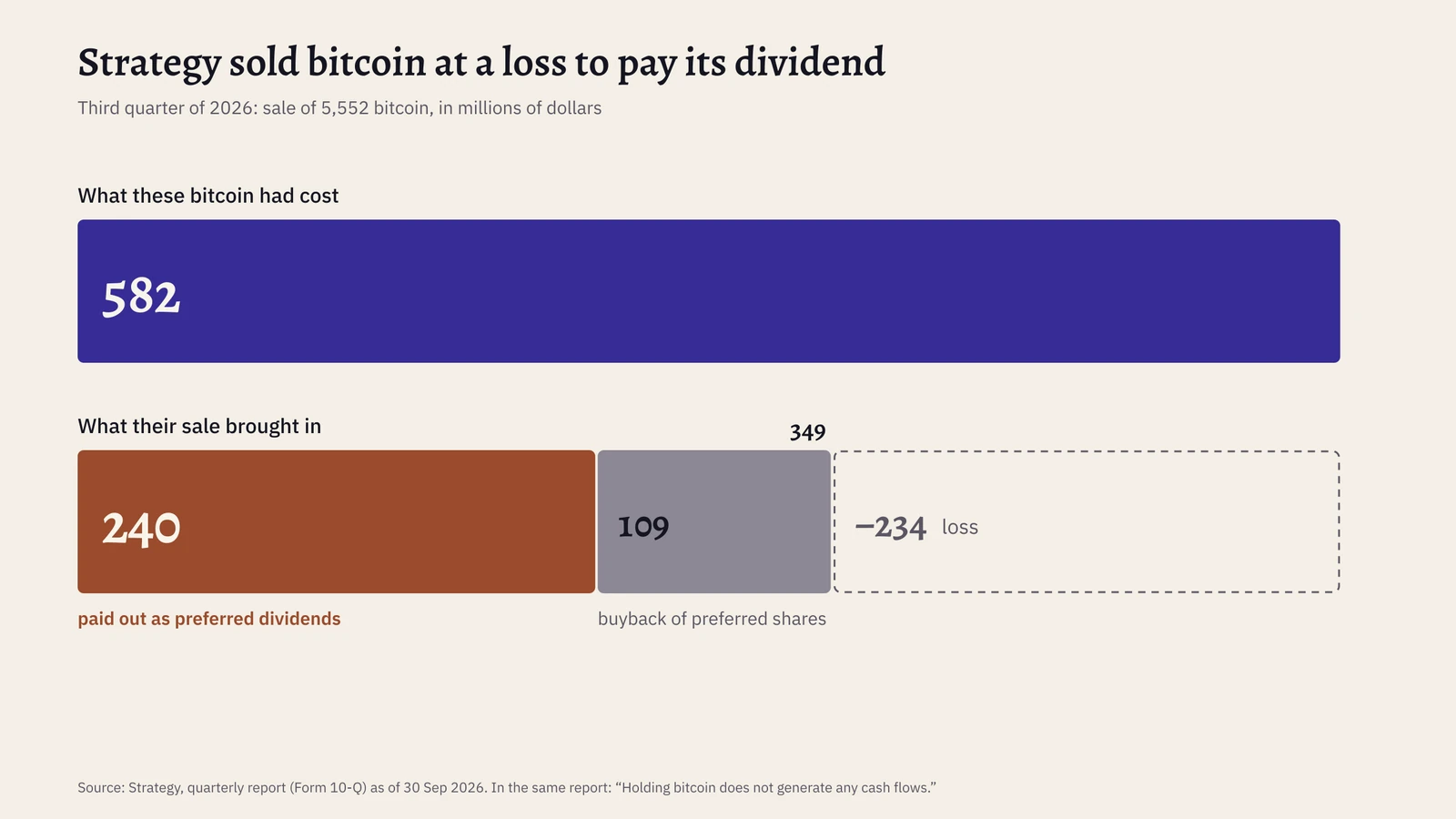
A yield on cash is in any case a contradiction in terms, for only someone who forgoes availability receives a yield. «Holding bitcoin does not generate any cash flows», the quarterly report states soberly. So the dividends in 2025 came from new shares and, since the second quarter of 2026, also from bitcoin sold; in the third quarter Strategy sold 5,552 bitcoin that had cost $582 million for 349 million, and 240 million of that went to the preferred shareholders. That is the consumption of substance dressed up as a coupon, a leveraged bet on continued monetisation. As a bet it may be legitimate; it has nothing to do with capital, credit or yield.
To be fair, Saylor has skimmed off two genuine rents: the premium that investors without direct access paid for the listed wrapper, and the sale of volatility through convertible bonds, for which hedge funds were glad to pay. Competition has been eating up both since spot ETFs and almost two hundred imitators began offering the same, and once the premium melts, what remains is a leveraged warehouse with senior dollar claims. That is no central bank, for Strategy lends nothing to anyone; Strategy is itself the debtor. In a productive company, by contrast, an admixture of bitcoin is a necessary cash holding for capital formation and thus a genuine component of capital. In the treasury company this formation is missing; all it produces are securities.
The arithmetic of the executive suites
This logic of the traditional financial system was amplified by the influencer model. Content and conferences face extremely difficult economic conditions in our time: information is free, distribution is everything. That is why the speakers at conferences are mainly influencers, who sell tickets through their reach, and sponsors, who want to sell something to the Bitcoiners. The biggest business I saw on the stages in this cycle was precisely the shares of the treasury companies, with all the fatal incentives of the classical financial world. The influencer brought the buyers into the hall, the sponsor bought itself visibility, and on stage the sale of a financial product passed for Bitcoin education. The multi-level financial salesmen have displaced the engineers.
How the executive suites enrich themselves in the process is in the public filings; one need only read them. Michael Saylor has drawn a symbolic salary of one dollar since 2014. His money comes from old options, that is, from the right to buy shares of his own company at a low price fixed earlier. The higher the share price rises, the more this right is worth. Under a trading plan he had set up in 2023, Saylor exercised all four million options in 2024 (split-adjusted); according to the company, the difference between the old purchase price and the market price came to just over $363 million. Chief executive Phong Le received $13.8 million in 2025, chief financial officer Andrew Kang 5.7 million, almost all of it in shares and options instead of cash. So they too earn from the share price: how many of their shares they receive in the end depends on whether Strategy's share does better than the Nasdaq over three years, and the committee that sets their pay expressly praised the «BTC Yield» of 74.3 percent in 2024. That is how the machine works: the leadership is measured and paid by the share price, and it fuels this price itself by issuing ever new shares, in the third quarter of 2026 alone for a net $5.4 billion. The common shareholders own only what is left after the creditors and the preferred shareholders.
At Metaplanet in Tokyo under Simon Gerovich, the favouritism can even be counted to the individual share. It has two parts. The first concerns a single investor. In January 2025 there were some 39 million Metaplanet shares. With the «21 Million Plan» the company granted EVO FUND, and no one else, the right to buy 21 million new shares. The fund was allowed to choose for itself on which day it bought, and then paid the previous day's closing price; if the price rose, it could resell at a higher price. Had it used all the rights, the existing shareholders would have retained around 65 percent of their company.
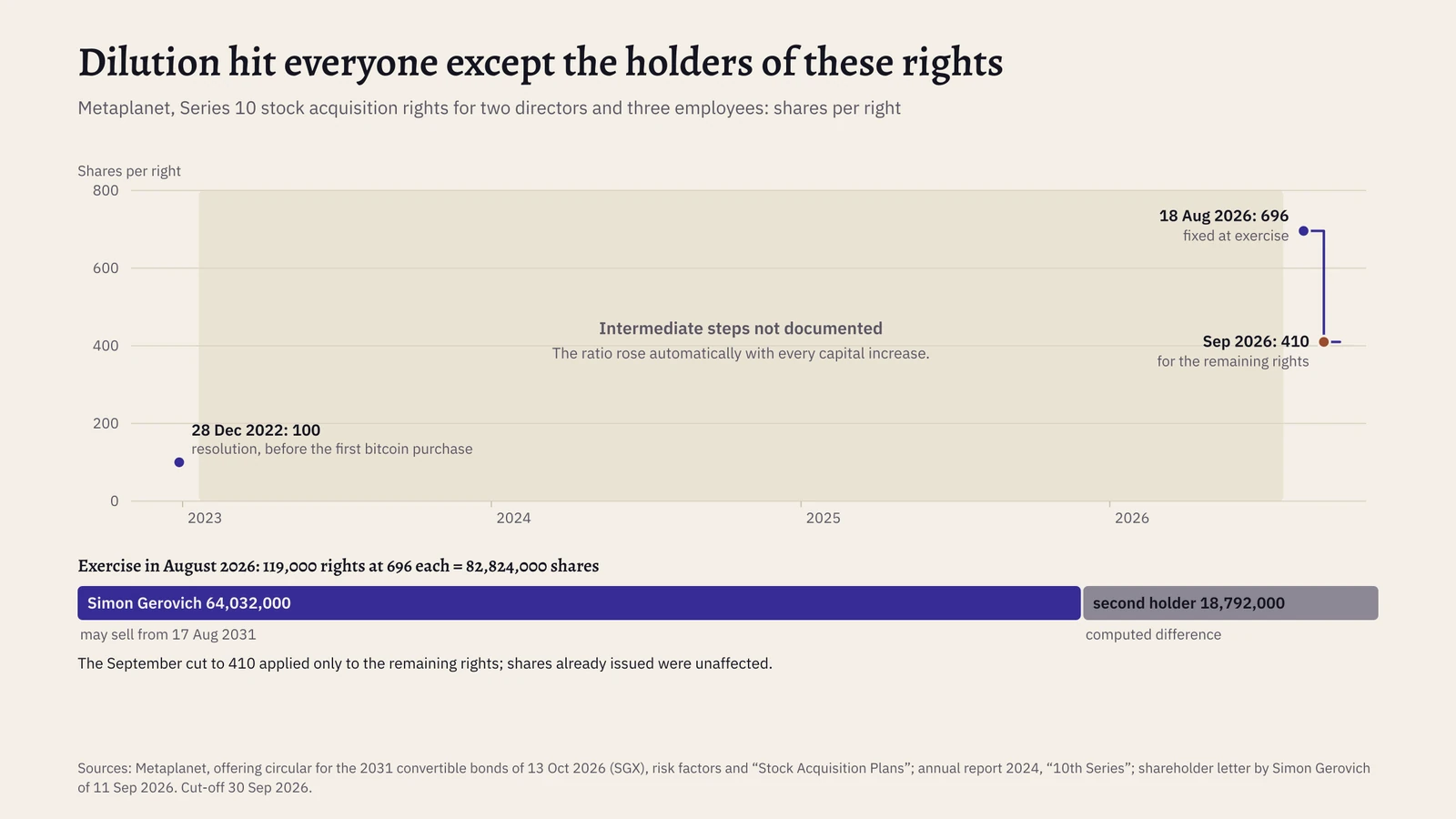
The second part concerns the leadership itself. Since December 2022, that is, even before the first bitcoin purchase, two directors and three employees had held stock acquisition rights of the 10th series, and each right originally allowed the purchase of 100 shares. When a company issues new shares, the stake of each existing shareholder becomes smaller; this is called dilution. These rights were protected against it, because with every capital increase the number of shares per right grew automatically, from 100 to 696. So their holders did not feel precisely the dilution that everyone else bore. In August 2026 two of them exercised their rights, and 64 million shares went to Gerovich; he may sell them only from August 2031. In September the company cut the rights not yet exercised to 410 shares per right, to be bought at 10 yen per share, and itself estimated the value thus cancelled at over $220 million. Gerovich's 64 million shares were, of course, left untouched.
The forgotten commons
The third weakness reaches deepest. People have spoken almost reflexively of the «tragedy of the commons» since Garrett Hardin in 1968. The actual commons, however, is no tragedy; it worked astonishingly well in the Alpine region, as Elinor Ostrom showed in the Valais village of Törbel: there, since 1517, each man could drive onto the common alpine pasture only as many cattle as he himself could bring through the winter. One's own work was the limit of one's claim on the others. The Alpine ban forests, protective forests that secure the slopes, are commons as well; in Andermatt the forest placed under ban in 1397 protects the village to this day. The commons is an expression of high trust capital, and the commons holds this capital together as the ban forest holds the slope.
Sadly, the last consumption of capital in the West is now taking place. The invisible capital of the high-trust societies has been consumed, by false elites and above all by mediocrity, which has used the state for its own benefit. Open source rests very heavily on this trust capital, and, far more than most suspect, the entire culture actually rests on it. Anyone can copy the code of Bitcoin. How dangerous it becomes when the few reviewers are exhausted was shown in 2024 by the Linux tool xz, whose unpaid maintainer was pressed by fake profiles until he trusted a newcomer, who promptly built in a backdoor.
This consumption shows in the disintegration of society into mutually distrustful bubbles. The disintegration is unavoidable, because conflicts of interest come to light. So too with Bitcoin: several splits have happened, with good intentions and expertise on all sides, but equally with short-sightedness and incentive problems on all sides. The most recent dispute was over a default setting for data in transactions, which made many switch to Bitcoin Knots, and in August a minority even split off onto a chain of its own with BIP-110. The future is uncertain, and one can approach it only by tinkering, in trade-offs.
The greatest test is still to come. For a good third of all bitcoin the public key lies exposed, and what is to happen to these coins in the event of a mathematical breakthrough is unresolved. If the coins are frozen, the saver who has carefully kept his key for twenty years is deprived of his property. If the coins are left movable, they may belong to the first stranger with the right calculation. If the occasion comes overnight, all that counts is the capacity for quick agreement, and that capacity grows only out of trust that was already there beforehand.
Substitute identity and civil war
That Bitcoin became a substitute identity for many prevents such processes of adaptation. This happened at a time of massive identity vacuum, in which many had the impression of having been betrayed by their previous identities and institutions. Of course this attachment is also necessary for Bitcoin, and it is unavoidable. Identity politics is, after all, a Western inheritance: identity politics follows from an interest in ideas, from the absence of strong kinship ties and from the possibility of choosing and nourishing freely chosen, abstract substitute attachments. Only, the very people who carry the protocol in bad times easily see in every rule change a betrayal of their last self-chosen belonging.
Bitcoin survived the first great civil war, the block size dispute from 2015 to 2017, astonishingly well, given the catastrophic drama then and since. In retrospect the big blockers were perhaps not entirely wrong on some trade-offs. The greatest damage, however, was done by the fact that even then no sensible compromise was possible any more, and in the end the utopian hopes of both sides failed: Bitcoin did not become the everyday cash of the world, and Lightning did not become the self-custodial payment network for everyone. All the public Lightning channels together hold fewer than 5,000 bitcoin.
In the end only network effect and antifragility counted. With bigger blocks, the scarce good the dispute was about could precisely not be multiplied: the willingness of others to accept the same coin. No fork brought more use as a medium of exchange, all of them are fading into irrelevance, and that has so far been the outcome of every fork: Bitcoin Cash today reaches a three-hundredth of the market value of Bitcoin and a sixtieth of its transactions. Litecoin, which was never a split, does settle more invoices than Bitcoin at some payment processors, but Litecoin never inherited the monetary network effect of Bitcoin; payment use and moneyness are simply different questions. In payments, in any case, quite different players won, above all the dollar stablecoins, of which over 90 billion Tether circulate on Tron alone. Even the strongest AI models bear me out when I play through alternatives to Bitcoin or redesigns of it with them: given the full context, the models become astonishingly modest. Monetary network effects are neither a purely technical problem nor a purely economic one.
My greatest reservation
Fungibility was always my greatest reservation. In «Geld her oder es kracht» I called fungibility the economic expression of «non olet»: money does not smell, and precisely that creates peace even between those who otherwise cannot stand the smell of one another. Fungibility in money was always an achievement of technology or law: gold loses its origin in the melting pot, the banknote loses it through the law that leaves ownership with the recipient in good faith. With Bitcoin every satoshi counts the same in the protocol, but every coin drags its public history along, and whether that history counts is decided by whoever accepts the coin. Those who accept are more and more often exchanges, custodians and large miners; three pools produce just over 60 percent of the blocks.
TradFi and political adoption could therefore restrict fungibility more than they increase saleability. The marginal buyer today is often a regulated custodian who has to check every incoming transfer for its origin, and in the EU anonymous accounts with providers will be banned entirely from July 2027. The developers of the Samourai wallet, which obscured the history of coins, were sentenced in the USA in November 2025 to five and four years in prison. At the same time an enormous layer of «paper bitcoin» has grown: a fifth of all bitcoin lies with companies, states, funds and exchanges, and the American spot ETFs keep over four fifths of their 1.25 million with a single company, Coinbase. For someone who easily loses his keys, a custodian may be healthier. But if millions choose the same custodian for the same good reason, a risk arises that none of them chose. The buyer of an ETF share cannot redeem any bitcoin, and the prospectus of the largest fund states that in a chain split the sponsor decides what «Bitcoin» means. That is, down to the detail, the architecture of paper gold. The conspiracy theory of secretly unbacked paper gold I consider folklore. History teaches something more sober, for as soon as the gold lay in a few vaults, redemption could be abolished with a stroke of the pen, from the surrender requirement of 1933 to the closing of the gold window in 1971.
Would a separation of paper bitcoin and real bitcoin then resemble a fork? More likely a split market would emerge, with the same chain and two prices, and such splits hold only as long as the state controls the bridge between the two segments. With Bitcoin the state controls the bridge to state money, hardly the chain. So far the friction shows in rejected deposits and frozen accounts; there is no second price for coins without proof of identity. Without the decentralisation of non-KYC bitcoin, however, the fundamental value of paper bitcoin breaks too, for that value depends on redemption, resilience and settlement between custodians. A claim to coins that may move only between approved addresses would be an entry in the slow database of a custodians' cartel, and American, Chinese, Russian and Arab custodians will hardly recognise one another's blacklists. In this way it is precisely the internationality of the bearer instrument that protects its fungibility. In a political emergency, which is what one holds an insurance asset for in the first place, paper bitcoin would be precisely the kind that can be confiscated.
The monitored holdings thus live off the free ones. Whoever holds his own keys, runs his own node, mines without filters or exchanges coins from person to person performs a service for every ETF investor who knows nothing of it and pays nothing for it. This is the same commons as with the source code, and it is overused in just the same way. With Bitcoin, fungibility is not a property that one owns and puts in a safe-deposit box; fungibility is asserted only through living use. My reservation therefore stands: whether the free holdings remain large enough to carry the monitored ones will decide more than any price.
Unwinding and new decentralisation
If Bitcoin survives this difficult phase, it will once again have gained greatly in antifragility. The greatest danger I see in the escapism of users who can no longer bear sovereignty in times of dehumanisation and no longer want to. Holding one's own keys means living without a safety net, which demands strength and character, and the harder the times, the more tempting managers, funds and gurus appear. With everyone who hands off the toil of freedom, the free commons on which everything depends shrinks.
The boom around Trump and Wall Street was comfortably consumed in advance, in hubris and complacency, and is now being unwound. From the appearance of Vice President JD Vance on the Bitcoin stage to the strategic reserve made of seized holdings, political recognition was already booked as profit. To cheer Trump and Wall Street for their rip-off was stupid and is now taking its revenge. All the same, the price still stands astonishingly high.
Decentralisation could finally increase again, through idealistic miners when the commercial ones capitulate, and some commercial miners are already selling their bitcoin, MARA most recently over 13,500 of them, and renting out their halls to AI data centres. And through real treasuries: productive companies that, in this insanely difficult world situation, see an admixture of bitcoin as a slight improvement in risk.
What must be built in the bear market
Bitcoin urgently has to solve its infrastructure problem, and that could only happen through patronage, through foundations and very long-term investors who carry the commons by paying for the necessary competence. Whoever improves block validation for everyone cannot send anyone an invoice. It would be the counter-image to the patronage in reverse that I described with the Satoshi statue.
In the engine room things look more serious than one would think from outside; I hear this from experienced engineers who came to Bitcoin from industry. The Bitcoin Core team is younger and less experienced than its reputation would suggest, because time-limited grants attract career starters and miss seasoned engineers with families. Reviewing other people's code counts as drudgery for newcomers and becomes a bottleneck, and in the end what often prevails is whatever nobody objects to any more. There is no long-term architectural plan, and block validation, the most delicate part, really belongs right at the bottom, cleanly separated. Code, review and tests depend on GitHub; the code can be copied, while the shared work of the reviewers on this one platform is far harder to relocate. Funding is also heavily concentrated; one study attributed almost two thirds of the examined grant funding for 2023 to two organisations, and the largest funders each came to barely one and a half million dollars for Bitcoin Core. Previous foundations were not set up to be long-term and competent enough, and the incentives were bad. This is not to deny how much commitment went on out of sight. What would be needed, however, is a permanent team of experienced engineers in lasting employment, which independently rebuilds components and introduces them step by step, perhaps even in an implementation of its own whose improvements others can adopt, without that implementation depending on the approval of the others. Something like this hardly yields a profit, and precisely for that reason it needs patrons who secure a living for an experienced reviewer and put up with that reviewer's objection even when the objection hits the patron's own pet project.
The saleability of Bitcoin, too, its most central monetary property, depends far more than most suspect on very long-term investors whose low time preference already borders on the altruistic. Of course the patient holder helps the seller only if the holder still has the means for a purchase. The treasury companies have contributed little to this; they tend to amplify volatility rather than reduce it, for whoever must first sell his own shares before the next purchase drops out as a buyer in a sell-off.
Before that, of course, the cultural rubble of the boom has to go. The dumbing down now has a name, «retard maxxing», a word from the looksmaxxing milieu that in March even Marc Andreessen picked up. About «Bitcoin education» one can only say: everything has already been said, just not yet stupidly enough. This also includes accepting it when people capitulate who let themselves be deluded too much and are now disillusioned. Their exit takes nothing away from the use value of the bearer instrument.
In the bear market, building gets done. The need has not become smaller, but the lucrative, short-term, comfortable deceptions must be overcome first. Bitcoin is dead again and will probably survive this death too. Possibly Bitcoin is dead as a panacea, as a hundred-percent HODL hope, and reborn as a tool that helps with survival in uncertain times, not as a hope of quick riches.
Rahim Taghizadegan is the last Austrian representative of the Austrian School in the direct tradition, entrepreneur, author of more than fifteen books, university lecturer, and the founder of scholarium, citadel.garden, and deedsats.
Scholia by email · since 2009
Scholia. Monthly marginal notes by Rahim Taghizadegan on the present, written in the mode of the Viennese school.
One issue a month. Your address is never passed on; unsubscribe with every issue.